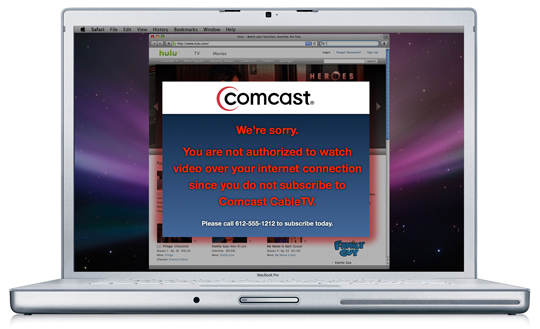
 Are you enjoying the ability to watch TV shows and movies streamed through the internet to your computer or media center with the likes of Hulu, Joost and all the others? If the cable companies and other network providers have their way, your connection will need to be “authenticated” — verifying that the location of your internet connection also subscribes to cableTV — before you’d be able to watch video through your internet connection.
Like most strategic moves, this ‘authentication’ one seems benign on the surface. One provider, Comcast, is positioning the use of authentication only for their Hulu knockoff, Fancast, rather than for the competitive sites like Hulu itself. The way that authentication would work is that you’d start streaming a cableTV subscriber-only show or movie to your computer or media center, but then find that it would only be accessible to you if you also had a cableTV subscription!
How benign is this strategic and likely anti-competitive move? In my view, it’s not benign at all but rather setting the stage for the next phase of video delivery — already begun through the internet and accelerating rapidly — and for those who already control your internet connection to be in charge of what content can be delivered and whom can deliver it.
GigaOm‘s Chris Albrecht wrote a solid article here for BusinessWeek and Will Richmond dug a little deeper in this one on VideoNuze. Albrecht pointed out the following which I immediately saw as the most likley rationale for cable companies and others to move forward with authentication as one of the first control measures for video delivery over the internet:
Multi system operators (e.g. cable companies) pay networks big fees to carry programming, and as such are unhappy that networks are turning around and putting that content online for free. The result? Cable and media companies like Comcast (CMCSA) and Time Warner (TWX) are developing plans that require viewers to prove they have a subscription to an MSO before they can watch video online. Comcast is calling its plan “On Demand Online” and Time Warner’s is dubbed “TV Everywhere.”
So why am I concerned about the possibility that the MSO’s are trying to muscle their way in to internet delivery of video? How about the fact that my new Mac mini media center has exploded our use of streaming video and opened my eyes to the dizzying array of video channels, new offerings from services like NetFlix ($8.99 to stream hundreds of movies instantly), and amazing, innovative and quality tech channels like Revision3? Also, why does this strengthen my belief that the Minnesota Ultra High Speed Broadband Task Force must recommend regulations for all MSO’s to our State Legislature this fall? … [Read More…]
 In a world that is shifting from serial and linear processes (which can be easily outsourced) to one rapidly moving toward higher value being created by those people who can deal with the flood of information and ideas coming at us in parallel by making new associations, any of us who care about our kids and the next generation of workers and leaders intuitively understands the value of mentoring. This past weekend’s



 Ever watch video or TV shows over the Web? How would you feel if this became one of your preferred methods for doing so and your cable or internet provider said, “No…that’s not allowed?”
 This week’s show is a discussion primarily about the future of newspapers…and the Minneapolis StarTribune in specific.