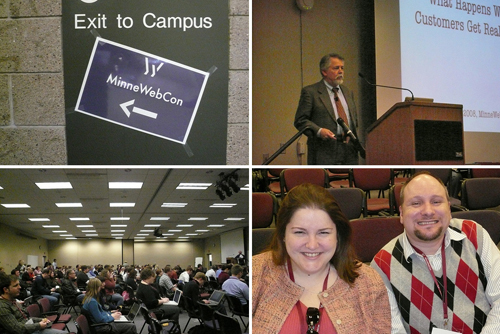
Yesterday’s MinneWebCon was a surprisingly packed event at my rough estimate of 400-450 people. The event was a full-day, three-track, continuing education conference for web professionals with the express intent of providing a venue to deliver “…technical and creative information from industry practitioners and educators directly to University of Minnesota staff, students, and web professionals from ad and design agencies, corporations, non-profit organizations, and other higher education institutions.“
The event was led off with a keynote by a key technology thought leader, Doc Searls, who famously was one of the authors of the seminal work, “The Cluetrain Manifesto“, required reading for anyone interested in the essence of conversational marketing, social media, and the shifts that were just beginning to occur when this thing called the Web was fairly new and the object of unrealistic expectations by too many chasing “eyeballs” instead of people.
At a high level, Doc discussed the progression from Cluetrain to today, telling stories which highlighted what many of us know as obvious truths when it comes to being a web participant. He spent time on a very interesting initiative, Vendor Relationship Management (VRM) as a much needed, power balance between we “customers” (managed within CRM or Customer Relationship Management software) and the vendors who’d like to sell us their stuff.
Sessions on tools, design, technologies, social media and much more were delivered to an audience of people who primarily make their living creating and building Web sites, assets and applications.
The second keynote, Web Culture & Privacy, was by security expert Bruce Schneier. With such quotable gems as, “Security does not equal privacy. Ephemeral is dead” and “Eventually we will have a president who sends LOLcats to other world leaders,” he really brought significantly more awareness to the audience about privacy and was clear that the only way to ensure privacy “…is to legislate it,” making the point that we need to become aware, pressure lawmakers, and drive legislation that makes it possible to retain privacy in an age where digital bits of ourselves are everywhere.
Hats off to Kris Layon and the team at the University of Minnesota for pulling off such a successful event and for opening it up to outside-the-university attendees.
 A group of Star-Tribune employees have launched a new campaign aimed at engaging the community to come up with new ways to save the bankrupt newspaper. What I find most innovative with the ‘Save The Strib’ effort is the use of social media to spread the word via
  Ever watch video or TV shows over the Web? How would you feel if this became one of your preferred methods for doing so and your cable or internet provider said, “No…that’s not allowed?”
 Well, one local entrepreneur, George Reese, is right smack in the middle of all this buzz, and is in a position to help clear up a lot of the confusion about it — especially for enterprises looking to take advantage of the economic benefits of this form of computing.
  His new book on the subject is scheduled to be released by O’Reilly on April 10. It’s entitled

 Last week was a busy one for many in the interactive community here in Minnesota. As chronicled by Minnov8,