Thirty Semifinalists Named in ‘Minnesota Cup’ Business Plan Competition

I attended and Twittered a bit at a reception Wednesday evening, June 25, at the grand, old James J. Hill Library in downtown St. Paul. (You remember old J.J., don’t you, the Bill Gates of his era?) It was an event to honor the startups who made it to the next round of the Minnesota Cup, an annual, statewide competition that seeks out aspiring entrepreneurs and their breakthrough ideas. The 30 lucky semifinalists were selected from a record of 840 entries in this fourth and largest year of the competition, and will vie for prizes that include $50,000 in cash for the first-place winner. An interesting tidbit I picked up at the reception: about 10% of the 840 entrants were Web 2.0 related.

Scott Litman, cofounder of the event, told me the competition this year was the toughest ever, and that many plans that might have made the cut in previous years didn’t. He also told me that, unfortunately, many entrants may have had great business concepts, but they were not understandable — the submissions were either poorly written, or riddled with so many acronyms and buzzwords that the judges flat-out did not know what the heck the submitter was talking about. (So, take heart, rejectees. You may be great at selling your ideas verbally — now work on the written word.)

Here’s how the Minnesota Cup site states its mission: “We’re looking for the next great entrepreneurial success story in our state. This competition is for all entrepreneurs, whether your breakthrough idea is high tech or no tech, whether you are just putting your ideas into a business plan or if you’ve been out building your venture.” Well, I wonder if it’s possible that any who entered, and especially the chosen semifinalists, could really be “no tech” in this day and age? That would be hard to imagine. And, in looking over the list, there’s nary a one that would seem not to rely on technology in their businesses. (Although some without a website certainly have the aura of no-tech at this point, perhaps awaiting prize money to build? And what’s with all the student semifinalists being listed with no websites?) As for the lack of a requirement that the business be new, i.e., that older startups can also apply, I know at least two on the list are four to five years old and still chasing $50k. Ah, hope springs eternal. Here’s the full list: Read more

Minnov8 Gang Podcast - Episode 2

Hosts: Steve Borsch, Tim Elliott, Graeme Thickins, Phil Wilson

Our second podcast where we discuss:

- Qwest laying fiber in Eden Prairie

- Jon Gordon of public radio’s Future Tense is coming to Minnesota, asked via Twitter for independent coffee shops with Wifi, and Minnov8’s Garrick Van Buren put up this invite-only Google map so the community could input them for Jon’s upcoming visit

- Discussed Minnesota Cup; Techcrunch’s Elevator Pitches site; PunditWatch at hubdub; Internet Broadcasting (and the editing of Tim Russert’s Wikipedia page and subsequent firing of an employee over those edits) and this coming Monday’s article on them by the Pioneer Press which will be here; Mashable’s post on Twitter; FriendFeed; Loren Feldman’s teasing of Shel Israel with the “Shel puppet”.

Our intention with this podcast is to talk about relevant innovations occurring in Minnesota and/or those that directly impact our State….and like good geeks we’ll undoubtedly go off on tech tangents periodically.

We’ll be recording one each week (releasing on Saturdays or Sundays) but will be a bit sporadic throughout this summer and recording them in earnest this Fall, with periodic guests appearing on the show. Look for Episode 3 the weekend of July 26th (due to vacations).

Thanks for listening!

 
icon for podpress  Minnov8 Gang Podcast - Episode 2 [53:55m]: Play Now | Play in Popup | Download

BlueShirtNation: Success from Risking Failure

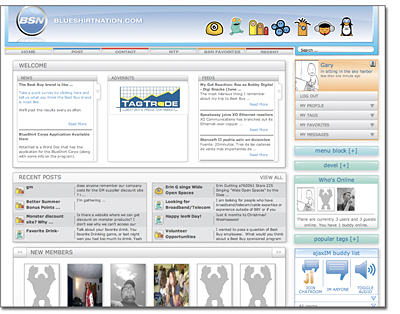
Connecting thousands of high turnover, twenty-something retail employees into some sort of cohesive and connected online network would seem worthy of senior executive leadership, strategy formation, funding, project managers and endless meetings to ensure that it was aligning with the goals and objectives set forth at the outset. None of that happened with one of the most visible employee social networks yet deployed, BlueShirtNation.com, which is Best Buy’s blue, polo-shirted retail employee online network for internal use only.
Instead Gary Koelling, now Senior Manager of Social Technology at Best Buy, was in the advertising department with his colleague, Steve Bendt (also now a Senior Manager of Social Technology). These two went ahead and built just such a network and did it on the cheap and outside the confines of the organization. As you’ll soon learn, they did so with great success, but this is a cautionary tale.

The BlueShirtNation adventure began because these two didn’t think their advertising was as effective as possible and they were wrestling with new methods to reach people in 2006 — especially how to reach those in the Millenials demographic — and had been doing so by going out to the stores and talking to retail employees. As they explored ways in which to connect people and have them be involved with input into messaging and advertising, they’d been playing around with podcasting and some other ideas but hadn’t hit on the right solution.

They knew that employees wouldn’t fill out surveys online or other online feedback mechanisms so Koelling, who had been using the open source content management system Drupal, cobbled together something with that platform in order to test out an idea: building some sort of destination site that employees could use to connect with one another, share content and information, and other typical uses of a social network, giving these ad guys and their department better visibility into what these customer-facing folks were thinking and experiencing in the stores daily. Read more

Minnov8 Gang Podcast - Episode 1

Hosts: Steve Borsch, Tim Elliott, Graeme Thickins, Garrick Van Buren, Phil Wilson

Our first podcast where we:

- Give a one minute overview of who the heck we are

- Discuss Minnesota Cup; Slantly; Cullect

- Chat about a variety of tech topics.

Our intention with this podcast is to talk about relevant innovations occurring in Minnesota and/or those that directly impact our State.

We’ll be recording one each week (releasing on Sundays) but will be a bit sporadic throughout this summer and recording them in earnest this Fall, with periodic guests appearing on the show.

 
icon for podpress  Minnov8 Gang Podcast - Episode 1 [40:18m]: Play Now | Play in Popup | Download

Backstage Gallery: Your Ticket to Music Memories

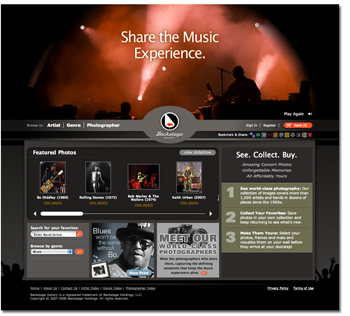
Imagine having access to hundreds of thousands of high quality photographs of your favorite musical artists. Glimpses of concerts past. Peeks backstage and views of these musicians as they prepare for, or wind down from, their time on stage.

Backstage Gallery is a Minnesota born company that launched last month and is delivering exactly that online.

The idea for it emerged from the mind of the now retired Best Buy president of US retail stores, Mike Keskey, as he searched for high quality photographs of his favorite musicians for his new media room in a second home located in the Brainerd Lakes area.

Going online and searching he found numerous outlets at the low end selling cheap, cheesy posters alongside a handful of high end galleries that charged in the thousands of dollars for prints of photographs from renowned, published photographers.

After an exhausting search for photos suitable for framing that weren’t pedestrian or a cliche, Keskey thought, “there has to be a better way and there’s a business here!” Read more

 
icon for podpress  Backstage Gallery Interview with Kim Garretson [25:22m]: Play Now | Play in Popup | Download

Kwingo Launches Mobile Language Apps

What do you do when you’re a successful, female, mid-career IT and operations executive with several big-name companies, and you decide to try something different? Why, you launch a mobile web apps company, that’s what!


Actually Lisa Foote first took some time to give back by using her executive skills for a year or so of non-profit charity work (with the United Way of Minnesota), after successful stints at Target, GE Capital, and Prudential. But it wasn’t long when the for-profit drive was back, and soon she was plotting, with husband Brad Roberts, a new business idea for solving language challenges in today’s increasingly global economy. And it just so happened that Web 2.0 technology was going to play a part — because Brad, who has a highly eclectic creative and business background, had become a self-taught Ruby on Rails developer.

The Birth of Kwingo
Foote and Roberts newly discovered life as entrepreneurs soon resulted in the birth of Kwingo.net, a venture they introduced earlier this year. Its mission is to bring simple, useful productivity tools to professionals working in field occupations using web-based mobile devices as a platform for delivery.

With her experience working in large enterprises, Foote knew that labor workforces were continuing to globalize, and that language challenges would just continue to multiply. Kwingo would provide the tools workers in the field needed to communicate with coworkers who speak a different language, helping everyone work more productively and safely. Read more

CodeMorphic Is One of the First In Line with iPhone Apps

It’s almost the end of the week and, being a site centered on tech and innovation, I believe we have been remiss in not including a picture of a 3G iPhone and a story having something to do with it. Well…when the iPhone AppStore opens in July, Minnesota startup CodeMorphic is all set with native applications for iPhones of all kinds.

Longtime friends Damon Allison and Bill Heyman launched the company in early March, coincidentally around the time as the Apple iPhone SDK release. There is a sense of serendipity about how they landed in the first group of iPhone developers among the two but they believe their focus and quality coding was the key to being noticed and landing at the front of the line. They feel their singular focus on just building native applications for the iPhone, and not moving into other mobile platforms, will prove to be the best business model.

Heyman noted there is tremendous opportunity for application development in the enterprise market. “There will be great growth in developing internal corporate applications.” Areas like work flow, communication are clearly opportunities.  Heyman continues “Right now that’s an area dominated by Blackberry so we see more needs for those types of applications for iPhone.” The consumer is the other opportunity. “Consumer focused applications that promote the brand, for example if General Mills were to target a younger consumer, where the iPhone or iPod Touch are really popular, they could develop an application or game that is tailored to them.Read more

Innovation Seminar in Bloomington

Turning Your Innovations into a Successful Business: Attracting Venture Capital and Business Partners While Protecting Your Innovations. This free seminar will take place on Tuesday, June 17th from 7:30 a.m. - 10:00 a.m. at the Hotel Sofitel in Bloomington, MN.
This year’s sponsors include The Innovators Network and the Minnesota High Tech Association. Andre Carter, Author and President of Irimi Corporation; James J. Paige of Nikolai & Mersereau; James T. Nikolai of Nikolai & Mersereau and Dan Mallin of SDWA Ventures will be presenting. All local technology firms and interested persons—whether you’ve already obtained a patent on your innovation, have a patent pending, or are considering submitting a patent application—will benefit from attending this event.

To Register, please visit this page.

Cost: FREE with complimentary breakfast

For more information call Melissa Moskal at 202.420.7484.

Enleiten: A Social GTD

If you have any interest in personal or group productivity, it’s likely that you’ve at least become aware of David Allen’s Getting Things Done (GTD) system. It’s not only taken the corporate world by storm, it’s become the geek method/tool/approach of choice for moving far beyond a simple to-do list. The system has even spawned productivity sites like 43 Folders, an homage to one element of the GTD system, as well as its own blog and news site dedicated to GTD-centric productivity called GTD Times.

Due to the success of Allen’s GTD methodology and the sheer volume of software developers among the ranks of the faithful, tools abound for using the GTD method. From David Allen Co’s own Microsoft Outlook add-in to dozens of offerings for PC’s and Mac’s (as well as other types of tools), most work well but suffer from an increasingly evident fatal flaw: using GTD is a problem if all of your data is sitting on a single computer. More and more of us are on multiple devices and mobile…using a laptop, smartphone, desktop at home and the office (and even casually using computers in coffee shops, airports or at a friend’s house) and need to use GTD but be able to access it anywhere we have an internet connection.

In 2007 Eric Hedberg, an economics major from Carleton College, worked at Secure Computing and Stockwalk.com, the latter in financial sector software, and Hedberg became aware of the direction applications were taking by being delivered “in the cloud” (i.e., as Software-as-a-Service (SaaS) hosted and available to anyone with an internet connection) and started looking at ways to implement a SaaS data warehousing/workflow management application for the financial services industry.

After some prototyping and user feedback, he and his college friends who’d joined him (Doreen Hartzell, CEO, and Steve Bentley, in charge of interface design) realized that the best part of what they’d built was the project management piece, which delivered collaborative online workspaces using a GTD model. That revelation spawned the current company focus, Enleiten, which is a collaborative GTD application delivered in the cloud and available for single consumer users, small groups or businesses. Read more

Commercial Real Estate Search Made Efficient

As the Internet increasingly becomes a platform upon which entrepreneurs and opportunists build disruptive and inefficiency crushing innovative Web applications, organizations like GoFishCommercial will emerge to do exactly that and make the inefficient, efficient.

After hearing about the company and taking the time to poke around the site, I had the chance to talk with Asher Silber, VP of Sales & Marketing for GoFishCommercial, in order to understand their current deliverable and a bit more about where they’re headed.

Kristi Oman (commercial real estate developer and property owner) and husband Zev, looked at the simplicity and effectiveness of Craigslist and knew they could build and deliver a site that would match that and add significant value to both the search process by buyers as well as to the owners of commercial real estate and their brokers.

What is particularly intriguing and innovative, however, is how GoFishCommercial has aligned the incentives of buyers, property owners and brokers, and done so in a disruptive and efficient way. Read more

Next Page →