 It is likely you’ve heard many times that small business is the engine of the U.S. economy and employs more than 50% of workers in our country. Over a recent 15-year period small businesses created some 65 percent of the net new jobs in the private sector according to a report, “Analysis of Small Business and Jobs” (PDF) from the Small Business Administration office of Advocacy—it’s equally true that the net job losses due to our economic downturn have hit small business hard in many ways.
Many Minnov8 readers automatically assume that startups and new businesses are the key to being the growth engine the U.S. and Minnesota needs. While that’s absolutely true, the Advocacy’s analysis of the quarterly Bureau of Labor Statistics data shows that over the 15 years from 1993 to mid-2008, 31 percent of net job gains (jobs created minus jobs lost) came from the creation and destruction of businesses (net employment change from business entry minus business exit) BUT an even larger share—the remaining 69 percent—were from businesses that were not new, but survived.
Small business has been hit just as hard as the rest of the economy and oftentimes cannot withstand recessionary forces as well as bigger businesses with either deep pockets or access to capital. As a consequence, many are turning to powerful and inexpensive methods to get the word out about their businesses, engage their loyal users and build a following, and are doing so in some unique ways.
For those of you who are actively using social media—blogs, Twitter, Facebook, even the old standby, email—you know that more of us than ever are paying less attention to traditional media and more attention to new forms of media and communications and therefore coming across businesses who are using it for communicating with us. Some local savvy small business leaders are taking matters in to their own hands with interesting results and to make certain they’re one of the 69 percent that survive our economic downturn.
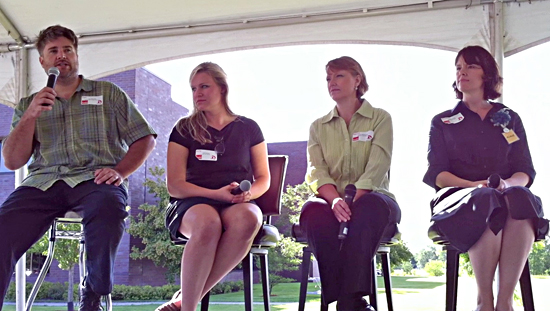
l-r: Dan Marshall, Julie Warner, Naomi Williamson and Aimee Pelletier
Friday found the Minnov8 team at the Social Media Breakfast/Minneapolis & St. Paul (SMBMSP) for a panel discussion about small business and how to leverage social media for fun and profit. It was led by Jason DeRusha (a reporter at WCCO-TV & is at @DeRushaJ) with panelists Julie Warner of WarnersStellian (@WarnersStellian); Aimee Pelletier of DarnKnitAnyway (@darnknitanyway); Naomi Williamson of Sanctuary Restaurant (@SanctuaryRest); and Dan Marshall of Peapods (@PeapodsNatural).
Each of the panelists had stories about the impact of social media on their businesses and that it was contributing to growth. Marshall talked about ways they connect with mothers and foster word of mouth; Warner of connecting with both those who are positive about WarnersStellian and, especially, those who have had negative experiences so as to turn their perception toward the positive; Williamson discussed the ineffective use of traditional media (e.g., advertising in restaurant guides brought zero results) and the impact of email marketing; and Pelletier of how reaching out with her email newsletter to current customers and how that approach continually built upon her customer base.
Though the group was light on analytics and anecdotal in their storytelling, each was firmly convinced that it was making a difference in their businesses and they could each cite results that backed up their claims.
This all begs the question for a site that focuses on web and internet innovation: Should the focus of innovation be just on startups, or is it perhaps just as important to educate, empower and encourage innovative use of technologies in businesses we need to survive? Any way you look at it, the Bureau of Labor Statistics data shows that the survival and saving of jobs in small business is more important than just starting up new ones.
What do you think?