Minnov8

Showcasing Minnesota Technology Innovation

  • Home
  • Minnov8 Gang Podcast
    • Complete Podcast Posts
    • MP3 Archive of All Episodes
  • Blog
  • About
  • Contact

OK. Internet Video for You…But With CONTROL

June 24, 2009 By Steve Borsch

no-video-for-you1It happened today. Time Warner and Comcast had a press conference to announce that they’ve teamed up to protect their cable TV franchises by controlling what is delivered over the internet connections they deliver to your home, effectively keeping out any pesky competitors or disruptors.

“Time Warner Inc. (NYSE:TWX) announced today that it has partnered with Comcast Corporation (NASDAQ: CMCSA, CMCSK) to develop broad principles for the TV Everywhere model to guide the distribution of its television content online.  The agreement between the companies will make it possible for Comcast customers to access programming from Turner Broadcasting’s award-winning entertainment networks free online and on demand.  In addition, Comcast announced it will begin a national technical trial of its “On Demand Online” service in July carrying programming from Time Warner’s Turner networks TNT and TBS.“

For our take on this issue, read “Sorry. No Internet Video for You.” In a nutshell, the cable companies are making all sorts of moves (e.g., bandwidth caps; caching infrastructure at the cable head-end; so-called “authentication” schemes) in order to control internet video distribution over their cable internet connections. If you don’t think this will harm any competing providers or innovators — whether major network initiatives like Hulu or upstarts like Revision3 — then you’re not paying attention.

The only possible option to counter the dominant, monopolistic footprint Comcast and Time Warner enjoy and to keep the internet conduit from becoming a toll-road benefitting a few — and that those few are clearly capitalizing upon in a way sure to fail (think “authentication” won’t be hacked in a nanosecond?) — appears to be the Federal Communications Commission and Congress.

Filed Under: Innovation, Internet & Society, Internet & Web

VC Ann Winblad on Cloud Computing

June 24, 2009 By Steve Borsch

annwinbladAnn Winblad, a well-known and respected software industry entrepreneur and technology leader (and Minnesota bred entrepreneur!), is the co-founder and a Managing Director of Hummer Winblad Venture Partners. In 1976, following a stint as a systems programmer at the Federal Reserve Bank, Ann co-founded Open Systems, Inc. with a $500 investment, and turned it into a top selling accounting software company; eventually sold for over $15 million.

As a sidenote, I worked for a company called Clothier-Herold Co in the early 1980’s on the side of the firm that represented this little company called “Apple Computer.” The other side of the rep business sold Visicorp (Visicalc, etc.), Microsoft (which, upon going public, I thought would never make it) and a bunch of PC-oriented lines of product. In addition, our firm represented Open Systems, though none of us ever met Ann at the time.

A strategy consultant for prestigious clients such as IBM, Microsoft, Price Waterhouse, and numerous start-ups, Ann has co-authored the book Object-Oriented Software and has written articles for numerous publications. Ann received a BA in mathematics and in business administration from the College of St. Catherine, and an MA in education and international economics from the University of St. Thomas (Minnesota), which also subsequently awarded her an honorary Doctorate of Laws. She currently serves as a director of Voltage Security, Krillion, Mulesource and Star Analytics, a member of the Board of Trustees of St. Thomas www.stthomas.edu, and co-chair of SD Forum www.sdforum.org.

In this Idea Projects video, Ann talks about cloud computing and how by moving technology from location-based servers to a virtual environment, with expanded if not universal access, the opportunities for innovation increase exponentially. As a software funder she sees a trend towards 100% presence on any device at any time.

httpvh://www.youtube.com/watch?v=ip3kgMKvyIw

Filed Under: Innovation, Tech Investors Tagged With: cloud computing

Yugma Struggles

June 23, 2009 By Steve Borsch

yugmaIn a time when the global economy is still in a relative holding pattern, gas prices remain high and more of us are turning to internet-based products and services to meet our needs less expensively and with more power, I assumed that Yugma‘s strong value proposition and rock-solid technology would be ones that would carry them quickly toward profitability.
Turns out that’s not the case.

Though I consulted with Yugma in 2006 and learned first-hand how many competitive offerings there are in the screensharing and web conferencing space, I still was enamored by Yugma and its cross-platform support, along with the ease of use they built in to using it. I’ve kept tabs on their progress for the last couple of years, taking great pains to not write about challenges and difficulties they were facing which I’d learned previously from founder Lingaraj Mishra, since confidences are a key part of my value system and an obvious imperative for the management consulting work I do with clients (i.e., I keep my mouth shut).

An unfortunate turn of events occurred recently when a letter to shareholders was publicly outed by WebConferencingTest and they did this press release stating why they were removing Yugma from their rankings (which I learned about today via this post at SkypeJournal and then learned more from this article at TMCNet).

I reached out to Lingaraj today to get the straight skinny from him about what’s occurring, what’s next, and whether Yugma really does have one foot in the dead pool with the other one poised to step in.  …  [Read More…]

Filed Under: Innovation, MN Entrepreneurs, Startups & Developers

U.S. Home Broadband Adoption Hits 63%

June 22, 2009 By Steve Borsch

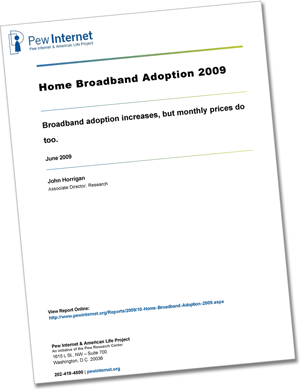
pewReaders of Minnov8 are skewed toward those highly interested or involved in internet and web-centric technology and services. As such, the latest findings of the Pew Research Center’s Internet & American Life Project will be of significant interest.

These findings illustrate a departure from the stagnation in home high-speed adoption rates that had prevailed from December, 2007 through December, 2008. During that period, Project surveys found that home broadband penetration remained in a narrow range between 54% and 57%.

The greatest growth in broadband adoption in the past year has taken place among population subgroups which have below average usage rates. Among them:

  • Senior citizens: Broadband usage among adults ages 65 or older grew from 19% in May, 2008 to 30% in April, 2009.
  • Low-income Americans: Two groups of low-income Americans saw strong broadband growth from 2008 to 2009.
    • Respondents living in households whose annual household income is $20,000 or less, saw broadband adoption grow from 25% in 2008 to 35% in 2009.
    • Respondents living in households whose annual incomes are between $20,000 and $30,000 annually experienced a growth in broadband penetration from 42% to 53%.

Overall, respondents reporting that they live in homes with annual household incomes below $30,000 experienced a 34% growth in home broadband adoption from 2008 to 2009.

  • High-school graduates: Among adults whose highest level of educational attainment is a high school degree, broadband adoption grew from 40% in 2008 to 52% in 2009.
  • Older baby boomers: Among adults ages 50-64, broadband usage increased from 50% in 2008 to 61% in 2009.
  • Rural Americans: Adults living in rural America had home high-speed usage grow from 38% in 2008 to 46% in 2009.

The Pew Internet Project’s April 2009 survey interviewed 2,253 Americans, with 561 interviewed on their cell phones.

As I read the report, it was clear that this acceleration in broadband adoption is, in my view, being driven by a number of variables: economic downturn causing a seeking of alternatives, efficiency and cost savings; friends, family and colleagues online (many using social media) creating compelling reasons for others to connect; and a continuing growth of online services in news, information, entertainment and more.

All that said, the important thing to Minnesota innovators is that people are increasingly online at home and participating, and that’s important to all of us in the internet and web innovation space!

Filed Under: Innovation, Internet & Society, Internet & Web Tagged With: cloud computing

We Can Tell You, or We Can Tell the World

June 15, 2009 By Steve Borsch

crowd_lg

“No matter who you are, most of the smartest people work for someone else.”

–Bill Joy, co-founder, Sun Microsystems


If you’re in business or lead an organization, you’re undoubtedly aware of the always on, always connected culture of participation online. The growing number of people participating in social networks, with social media and generating their own content in the form of blogs, videos and even scrapbooks, is fundamentally shifting how we are connecting with one another, getting our news and alerts, are being influenced by people we trust as we seek before we buy, and increasingly is how we’re making our voices heard when we like, or don’t like, something a company or organization is delivering to us.

Rather than stumble along with rudimentary methods of engaging customers, prospects, employees and other constituents, many organizations are turning toward commercial software vendors who have created a completely new class of hosted software offerings in a category called, “idea and suggestion management.”

If you’ve read Here Comes Everybody by Clay Shirky, Wikinomics by Don Tapscott, or even the seminal book on the topic, The Wisdom of Crowds by James Surowiecki, than you’re staying abreast of the acceleration in companies discovering ways in which they can embrace their customer base and ecosystem for fun and profit (but mostly the profit).

In a growing number of conversations I’m having with business leaders, virtually all of them are either engaged in some form of outreach to their customers, prospects, partners and employees or they have initiatives in place geared toward learning how their organization can effectively engage people in new and online ways. With enough input from unleashed online participations coupled with smart decision-making within organizational leadership ranks — especially in product management or strategy creation areas — the ability for a company to build and deliver the right products and services goes up dramatically.

One oft-cited example of harnessing the collective intelligence of ones customer base is the Chicago-based t-shirt company, Threadless. The way their business model works is simple: the community of 850,000 people participating online at Threadless “vote” on their favorite t-shirt design (submitted by designers within the community at a rate of around 600 designs per week) and those are the t-shirts that are printed and sold. Threadless is essentially “offloading” their design to the community and enabling the community to be their defacto product managers, deciding on what they (the market) wants.  …  [Read More…]

Filed Under: Innovation, Internet & Society, Social Media

Category to Watch: Idea & Suggestion Management

June 12, 2009 By Steve Borsch

IdeationSoftware

Of course you’re paying attention to the always-on, always connected culture of participation online that is fundamentally shifting how we connect with one another, get our news and alerts, are influenced by people we trust and increasingly making our voices heard when we like or don’t like something a company or organization is delivering to us.

If you’ve read Here Comes Everybody by Clay Shirky, Wikinomics by Don Tapscott, or even the seminal book on the topic, The Wisdom of Crowds by James Surowiecki, than you know about the acceleration in companies looking to figure out how to embrace their customer base and ecosystem for fun and profit (but mostly the profit).

In a growing number of conversations I’m having with business leaders, virtually all of them are either engaged in some form of outreach to their customers, prospects, partners and employees and learning how to engage them in new and online ways. With enough input and smart decision-making, the ability to build and deliver the right products and services goes up dramatically. I thought it a good idea to visit this topic now, especially as there now signs the economy is growing and we’re beginning to experience growth in our trend forecasting businesses, typically one bellwether pointing the way in the housing sector.

Best Buy is the “poster child” for this sort of engagement on a host of fronts. From the employee-only BlueShirtNation (now “Mix“) to Giftag to the relatively new and well executed IdeaX, they’re highly focused on driving forward and engaging on as many fronts as possible.

Though Best Buy is quite public with their offerings — along with an unusual level of transparency and engagement — General Mills is also going out with initiatives like MyBlogSpark to engage women who blog (dubbed “mommybloggers”) in order to engage the typical decision-maker in a household and are the ones who usually drive the family nutrition.

Back in March, the site ReadWriteWeb had a guest author, Tom Powell from Co-Innovative, who wrote this fabulous post on the topic and categorized leading idea and suggestion management vendors with an extensive writeup.  …  [Read More…]

Filed Under: Innovation, Marketing Innovation, Social Media

FCC & Broadband: Tell ’em What You Think

June 9, 2009 By Steve Borsch

boy_internet

If you’re a Minnov8 reader, your lifeblood is probably internet-centric. Heck…if you have a PULSE you’re probably an internet user and would care deeply if any internet service provider was allowed to be in control over what you can-and-cannot-do over your internet connection.

Well, don’t just sit there….

Friend of technology, the internet, Minnesota and Minnov8, Mike O’Connor, is on the Minnesota Ultra High Speed Broadband Task Force representing the metropolitan area user base and had this on his blog today and I urge you to take action:

Just got this note from Dennis Fazio.  I think it’s perfect so I’m just passing it along to you.  Time to speak out peepul!

Mike, You might want to encourage everyone to enter their comments to the FCC. A large number of citizen comments can help to counter the “everything’s just fine” mantra from the big telecom carriers. Here’s the Ars Technica article  with a nice background summary:

http://arstechnica.com/tech-policy/news/2009/06/reformers-isps-clash-on-national-broadband-plan.ars

The Notice of Inquiry is here for those who want to read through it:

http://hraunfoss.fcc.gov/edocs_public/attachmatch/FCC-09-31A1.pdf

But really all you need to do is submit your comments about what you think the future of broadband networks should be by going here:

http://fjallfoss.fcc.gov/prod/ecfs/upload_v2.cgi

It’s easy and quick You can upload a file, or more simply, type or paste a comment into the field provided.

You will need the proceeding number for field #1 and that would be:  09-51

A large number of knowledgeable citizen comments on the necessity of changing public policy to recognize broadband packet data networks as an essential public utility requiring active government investment, intervention and regulation might have some good effect.

Just so you know that I’m not asking you to do anything I wouldn’t do, peek at the letter I just submitted via the FCC website using Dennis’ link and the 09-51 code:  …  [Read More…]

Filed Under: Innovation, Internet & Society, Internet & Web Tagged With: Internet

Whip It Out: Your Smartphone Extends Your Mind

June 8, 2009 By Steve Borsch

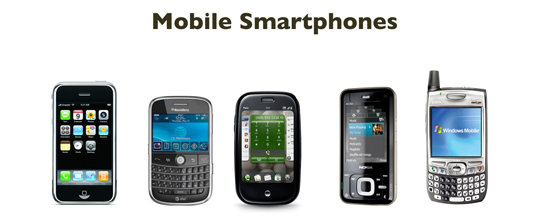
smartphones

Competition in the mobile phone space is heating up and the smartphone — a mobile phone with computer-like functionality — coupled with ever faster wireless network speeds are changing the way we access news, information, connections with our friends and family, and so much more.

A quick story illustrates one amusing (though not to my wife) use of my iPhone when I first got it. We were at a dinner party when the conversation came around to a particular song, but no one could recall who sang it. As the conversation continued I quickly used the web browser to Google the song name and roughly 30 seconds later blurted out, “Woody Guthrie!”

“Yes!,” everyone cried out simultaneously. “How did you know that,” one woman asked and I whipped out my iPhone to show how I’d quickly and almost instantly found the answer and we then had an interesting conversation about how the world was shifting toward one where we all could have instant access just like that.

A few years ago smartphones were few in number and came from manufacturer’s like Palm (e.g., Treo) and Nokia — and devices powered by Windows Mobile — were robust but somewhat limited in functionality and required an (arguably) geeky nature to use fully. The Blackberry device by Research in Motion (RIM) was a more limited one as far as applications go, but its external keyboard (to many the most important feature) and easy access to email (which was “pushed” to the device automatically) made it the perfect communication appliance for daily business use.

When Apple demonstrated and delivered the game-changing iPhone in June of 2007, its surprising ease of use and simple way to manipulate applications (e.g., pinching and zooming in on a photo or webpage) made a device like this easily accessible to the masses. Because of quick sales of the iPhone and a developer kit to build applications, Apple quickly saw a huge array of applications delivered on the device (more than 25,000 to date). Because of the simplicity of the device and the base of applications already available, sales accelerated to the now installed base of 21.2 million units and the announcement Monday, June 8th of a third generation model (and the second generation lower price point of $99) has caused most observers to see those numbers doubling within a year or so.  …  [Read More…]

Filed Under: Innovation, Internet & Web, Social Media Tagged With: iPhone, mobile

MIMA Presents Obama Online

June 4, 2009 By Phil Wilson

There has been much discussion about the new emphasis on the online and social media policies of our new administration. As Minnov8’s Steve Borsch noted back in November, “The Obama campaign’s effectiveness in delivering their messages and calls to action will be hyper-analyzed over the next several months.” Well our friends over at the Minnesota Interactive Marketing Association are giving us some of that analysis by presenting an “Integrated Campaign Case Study: Obama Online” On June 17th.
The event will be held at Nicollet Island Pavilion and feature Scott Thomas (aka SimpleScott). According ot MIMA you’re invited to “take a look at how the Obama campaign looked before (Scott) and other designers, joined the team for the last election season.” and promises “You’ll see how it was, how it evolved, and the lessons learned along the way. ”

Scott Thomas, aka SimpleScott, was invited to join the New Media team at Obama for America during the campaign and it led to him becoming the Design Director of the historic Obama Presidential campaign.

Filed Under: Events, Internet & Web, Marketing Innovation, News & Events, Social Media Tagged With: MIMA

Thought Leaders At-Your-Fingertips

May 24, 2009 By Steve Borsch

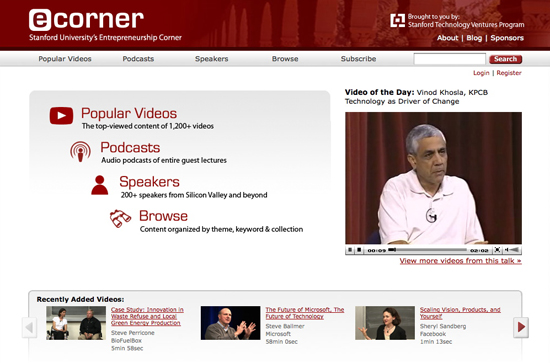
ecornerStanford University has an incredible resource that you’ll undoubtedly find quite useful: an entrepreneurship ecorner that delivers videos and podcasts from top names in technology.

From their About page:

The Stanford Technology Ventures Program (STVP) Entrepreneurship Corner is a free online archive of entrepreneurship resources for teaching and learning. The mission of the project is to support and encourage faculty around the world who teach entrepreneurship to future scientists and engineers, as well as those in management and other disciplines. The site has been developed by a dynamic team of educators, entrepreneurs, engineers, and designers at the Stanford Technology Ventures Program (STVP). The project has been financially supported by Stanford University and a number of generous sponsors. Other collaborators in its creation include the Stanford Center for Professional Development and Stanford Video.

One thing that was fascinating was from this post about why they’re translating their video’s audio and providing subtitles in so many languages, “Recent analysis reveals that over 40% of our viewers are visiting from outside the United States.” Also from this post is the factoid that they’ve created and are shipping an iPhone application to access their content.

Filed Under: Innovation

« Previous Page
Next Page »

Search

Minnov8.com Is Now An Archive

As of April 2017, Minnov8 posts and podcasts are now an archive as this site is no longer actively published. Thanks to all of you who have been reading and listening since our founding in 2008!

Minnov8 Post Categories

Connect with Minnov8

  • Email
  • Facebook
  • Twitter
  • YouTube

Minnov8 Gang Podcast

Page Update Notification

Be Notified When This Webpage Is Updated. Click “Ok” Below…

powered by ChangeDetection


Copyright © 2026 · Log in
This work is licensed under a Creative Commons Attribution-ShareAlike 4.0 International License.