
Minnov8

Showcasing Minnesota Technology Innovation

  • Home
  • Minnov8 Gang Podcast
    • Complete Podcast Posts
    • MP3 Archive of All Episodes
  • Blog
  • About
  • Contact

The Economist on Who is Controlling Your TV

April 26, 2009 By Steve Borsch

economistIt’s refreshing (and validating) to have a prestigious news organization like the United Kingdom-based Economist, write an article that supports the position I (and many others) have taken that ISP bandwidth caps and authentication are nothing but control measures to protect Cable TV revenues.

This past week, the Economist published this article about what’s happening in the United States as it pertains to the explosion in internet video viewing and the threat this poses to cable companies and started off like this:

“IN THE land of free enterprise and the home of discount shopping, there can sometimes be an appalling lack of competition. High-speed access to the internet is one. Cable television is another. The reason is that in America cable-television companies, which provide a lot of the high-speed access, do not want their customers to cancel their contracts and watch television over the internet instead. (SB: my emphasis).”

The article goes on to discuss what’s happening, how the cable companies sell bundles — sometimes with 100 channels or more — though the average consumer watches only 15. Now that we have an unprecedented ability to watch online TV, movies, video podcasts, and rent from Netflix or iTunes, many of us are asking a fundamental question: why do we want to continue to pay for what we don’t need or want?

The author does, in fact, cut to the chase and get to the essence of what’s happening (which I explained at length in previous posts):

“Consumers’ new-found freedom to choose has struck fear into the hearts of the cable companies. They have been trying to slow internet television’s steady march into the living room by rolling out DOCSIS 3 at a snail’s pace and then stinging customers for its services. Another favourite trick has been to cap the amount of data that can be downloaded, or to charge extortionately by the megabyte.”

PUT DOWN THAT REMOTE FOR JUST A MOMENT and connect NOW with the Minnesota Ultra High Speed Task Force members and let them know why and how this issue matters to you.

The Task Force needs to hear from you. They’ll be making their recommendations to the State Legislature this Fall and key portions of those recommendations are being formulated as you read this post. If they don’t hear from you and soon, they’ll never know an open, unfettered internet matters as much as we online participants do.

Minnesota Ultra High Speed Task Force Member Emails (full contact info here). Task Force chair, Rick King, has asked that all email correspondence be directed to Diane Wells (email) as she’s compiling them and releasing a daily digest to the members.
Filed Under: Internet & Society, Internet & Web

Digital Economy Fact Book ’08-’09

April 26, 2009 By Steve Borsch

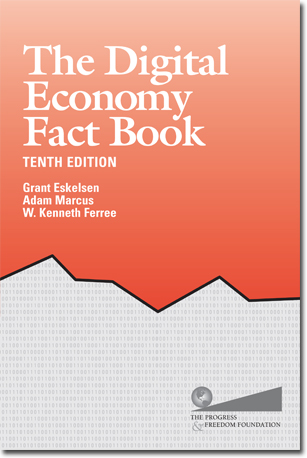
Cover of The Digital Economy Fact Book 2008-2009, 10th EditionHaving information and facts at-your-fingertips about the internet and web is absolutely critical whether you’re a startup needing content for your pitch, a marketer needing to understand a 40,000 foot view of trends, a corporate user needing to understand mobile access to the ‘net or international usage, or if you’re just someone like me: an info-junkie who needs a constant data fix in order to constantly track what’s hot and what’s not.

This report is put out by the Progress and Freedom Foundation, an organization that is a “…market-oriented think tank that studies the digital revolution and its implications for public policy. Its mission is to educate policymakers, opinion leaders, and the public about issues associated with technological change, based on a philosophy of limited government, free markets, and individual sovereignty.”

“PFF’s research combines academic analysis with a practical understanding of how public policy is made. Its senior fellows and other scholars are leading experts in their fields, with distinguished careers in government, business, academia and public policy. Its research is substantive, scholarly, and unbiased.”

Covered in the report are these key areas:

  1. The Growth of the Internet
  2. The Hardware Sector
  3. The Communications Sector
  4. Digital Media
  5. Electronic Commerce
  6. Threats to the Digital Economy
  7. The Worldwide Digital Economy

One of the best parts are the active links in each chapter’s EndNotes which allow you to drill down into many areas covered within this report.

Here is the download page and a direct link (PDF).

Filed Under: Internet & Society, Internet & Web

Best Buy Challenges You to Remix

April 25, 2009 By Steve Borsch

bbc_remix_challengeAnyone born in 1978, and now in their early thirties, never knew a time when there weren’t mainstream personal computers. For the most part, those who entered this world in the late 1980’s (and are in their twenties like my daughter), haven’t lived in a time when PC’s weren’t in their school or at home, and this thing called the ‘internet’ was in place before they were out of grade school.

Best Buy clearly recognizes that these digital natives are voracious users and purchasers of the technology they sell, but they also seem to truly understand that there is an entire ecosystem of these digital natives who have become web developers. These folks are adept and using new faster and more efficient tools (e.g., Ruby on Rails), a “web stack” (i.e., Linux, Apache, MySQL, PHP or LAMP) — along with leveraging the accelerating number of exposed application programming interfaces (API’s) available digital data that’s exposed — and are building and delivering a dizzying array of new web applications, mashups and remixes.

Curiously, the latter term “remix” is usually used in the context of someone taking an original song and mixing in other elements to create a new one, but in my opinion Best Buy has extended that term to include what they’re offering, an open API called “Best Buy Remix.” This API opens up Best Buy’s product catalog, featuring full product information including pricing, availability, specifications, descriptions and images for nearly a million current and historical products and thinking of using all of this to create a ‘remix’ vs. a ‘mashup’ seems to me to be positioning it as being used for an elegant and lyrical web application vs. what many people think of when the term mashup is used: connecting a database to a Google Map and delivering something of interesting but inherently low value.  …  [Read More…]

Filed Under: Developer Hub, Innovation Tagged With: Best Buy

Sorry. No Internet Video for You

April 24, 2009 By Steve Borsch

no-video-for-you1Are you enjoying the ability to watch TV shows and movies streamed through the internet to your computer or media center with the likes of Hulu, Joost and all the others? If the cable companies and other network providers have their way, your connection will need to be “authenticated” — verifying that the location of your internet connection also subscribes to cableTV — before you’d be able to watch video through your internet connection.
Like most strategic moves, this ‘authentication’ one seems benign on the surface. One provider, Comcast, is positioning the use of authentication only for their Hulu knockoff, Fancast, rather than for the competitive sites like Hulu itself. The way that authentication would work is that you’d start streaming a cableTV subscriber-only show or movie to your computer or media center, but then find that it would only be accessible to you if you also had a cableTV subscription!

How benign is this strategic and likely anti-competitive move? In my view, it’s not benign at all but rather setting the stage for the next phase of video delivery — already begun through the internet and accelerating rapidly — and for those who already control your internet connection to be in charge of what content can be delivered and whom can deliver it.

GigaOm‘s Chris Albrecht wrote a solid article here for BusinessWeek and Will Richmond dug a little deeper in this one on VideoNuze. Albrecht pointed out the following which I immediately saw as the most likley rationale for cable companies and others to move forward with authentication as one of the first control measures for video delivery over the internet:

Multi system operators (e.g. cable companies) pay networks big fees to carry programming, and as such are unhappy that networks are turning around and putting that content online for free. The result? Cable and media companies like Comcast (CMCSA) and Time Warner (TWX) are developing plans that require viewers to prove they have a subscription to an MSO before they can watch video online. Comcast is calling its plan “On Demand Online” and Time Warner’s is dubbed “TV Everywhere.”

So why am I concerned about the possibility that the MSO’s are trying to muscle their way in to internet delivery of video? How about the fact that my new Mac mini media center has exploded our use of streaming video and opened my eyes to the dizzying array of video channels, new offerings from services like NetFlix ($8.99 to stream hundreds of movies instantly), and amazing, innovative and quality tech channels like Revision3?  Also, why does this strengthen my belief that the Minnesota Ultra High Speed Broadband Task Force must recommend regulations for all MSO’s to our State Legislature this fall?  …  [Read More…]

Filed Under: Internet & Society, Internet & Web

Broadband Perspective

April 24, 2009 By Steve Borsch

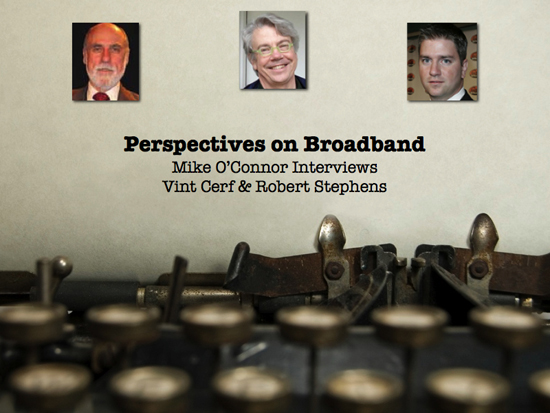
perspectivesMike O’Connor, urban representative on the Minnesota Ultra High Speed Task Force, recently interviewed the “father of the internet” Vint Cerf, as well as the head of Best Buy’s Geek Squad, Robert Stephens about their perspectives on broadband.

After the jump, you can watch Mike’s interviews (broken in to chunks due to YouTube’s limits on filesize). They’re very enlightening if you care about this topic!  …  [Read More…]

Filed Under: Internet & Society, Internet & Web Tagged With: Internet, mobile

It Was Cloud Week in Minneapolis, and All the Cool Kids (and Old Guys!) Were There

April 21, 2009 By Graeme Thickins

[Note: This post first appeared earlier today on the CloudAve blog.]

What a gorgeous spring week it was in Minnesota last week: clear, sunny, even sneaking into the ’70s.  sunbehindcloud The only “clouds” in sight were the proponents and would-be adopters of the latest, new hotness in enterprise computing.  Two events, on Wednesday and Saturday, attracted a wide array of these IT professionals, some 350 all told, who were hungry to learn more about… well, “the orange that’s the new pink,” as Larry Ellison would say. It was beyond impressive that so many people would give up being outdoors last week after the winter we’ve had in these parts!  Goes to show how deep our IT roots run in this state. Geeks are everywhere here and, doggone it, we’re proud of it!  We still have many old-school enterprise IT folks who remember the days of time-sharing on mainframes, and way more than our per-capita share of Fortune 500 headquarters in this state, all with huge (well, getting leaner) IT departments. But, along with all that, Minnesota has a seemingly endless supply of boot-strapped Internet and software startup developers — folks that are finding they love what cloud computing is doing for them.

So, it was an eclectic bunch that gathered at these two Minnesota cloud events, and I was there to take it all in…. …  [Read More…]

Filed Under: Events, Innovation, MN Entrepreneurs Tagged With: Best Buy, cloud computing, CloudCamp, enStratus

Oracle Drinks Up Sun: MySQL Questions Remain…

April 20, 2009 By Lief Larson

…Like is LAMP now LAMOP?

mysqlI’m personally aware of over 40 projects here in flyover country that are not only leveraging — but are wholly reliant on — MySQL. To make matters worse (and admittedly selfish on my part) our company uses MySQL across all our web properties. To see that megalith Oracle purchased Sun Microsystems today for $7.4 billion sent chills down my spine and left me with a nasty taste of cottonmouth.

Sure, there are a few of those Oracle fanboys out there that will say this deal means Java will get more technical attention than it’s been paid for years. Still, I liken this acquisition to a story I saw in a documentary called Flow: For the Love of Water. A segment in this movie shows corporate giant Nestle setting up a bottling plant in Michigan and stealing away millions of gallons of water from a stream running through that community, putting it in bottles, and then selling it back to local residents.

It no secret that I’m a capitalist, and that I believe that money is the root of all that is productive. My problem with what Nestle did is that they took what was already free and a universal right – clean and fresh water – and sold that under the auspices of having actually produced something. I too fear this will be the case with Oracle and MySQL.

MySQL has over 10 million installations around the world and it is the productive man’s database management system. MySQL occurs naturally and freely in nature. People take it and turn it into something meaningful. It was provided under GPL and its current form represents the untold contributions and real-world use cases of thousands and thousands of people. Now are we to expect Oracle to come, bottle it up, and sell it back to us?

This transaction only happened today, so I don’t want to be too quick to jump to conclusions. That said, you would sure think that a guy as smart as Larry Ellison would have made a community statement to appease me. I mean gosh, this guy has all the water he could ever dream of and now I find him standing over MY WATER holding a big-ass straw in his hand.

What do you think?

Filed Under: News & Events, Open Source

Wired for 2020: Mentoring Our Youth

April 20, 2009 By Steve Borsch

wiredIn a world that is shifting from serial and linear processes (which can be easily outsourced) to one rapidly moving toward higher value being created by those people who can deal with the flood of information and ideas coming at us in parallel by making new associations, any of us who care about our kids and the next generation of workers and leaders intuitively understands the value of mentoring. This past weekend’s Wired for 2020 event was solely dedicated to mentoring and I was delighted to have had a small involvement in this worthwhile venture.

Wired for 2020 is the Mentoring Partnership of Minnesota’s year long engagement campaign to get more mentors involved with youth in the state of Minnesota. Their mission is to interest caring adults in becoming mentors to youth. Caring adults who are willing to help young people spark their future career interests and expand their possibilities.

Sponsors included names such as General Electric, Best Buy, Target, Federated Insurance, MN Dept of Education, Minnesota Interactive Media Association, Qwest, Science Museum of Minnesota, 3M, Thomson Reuters and many more.

With a daughter in college and a son in high school, you bet I care deeply about the future of education and work, the world they’ll inherit from us, and the value we can add to kids if we can help them locate their own, personal spark within and help them to see possibilites and opportunities that match their dreams.

In a world where high paying, yet low value jobs can be done elsewhere at a fraction of the cost of labor onshore, the challenge is in coaching our youth on how they can each strive and focus on higher value work and that they can, in fact, invent the future. It won’t be easy as global competition continues to grow. …  [Read More…]

Filed Under: Events, Innovation Tagged With: entrepreneurship, MIMA, University of Minnesota

Panel to Discuss the ROI of Digital Marketing

April 12, 2009 By Graeme Thickins

A special event for senior executives and marketing professionals has been announced by long-standing Minneapolis web marketing firm Ciceron.  Entitled Radical ROI: Seizing the Potential of the Digital Marketplace, the half-day panel will be held Monday, May 11, 2009, from 8:00 to 11:00 am at the Midland Hills Country Club in St. Paul.  radicalroiforum

The event offers attendees a chance to hear how a panel of local business leaders have transformed their organizations to thrive in the digital marketplace — and I am privileged to be one of those panelists:

• Paul Douglas: CEO, Weather Nation (and former chief meteorologist, WCCO TV)

• Jan McDaniel: CEO, JTM Vision (and former CEO, American Red Cross Twin Cities)

• Phil Hotchkiss: Founder, BigCharts.com

• Joel Kramer: Founder, MinnPost.com (and former Publisher, Minneapolis Star-Tribune)
[Note: Minnov8 syndicates some of its content to MinnPost.]

• Graeme Thickins: Founder, GT&A Strategic Marketing

• Andrew Eklund: CEO, Ciceron Digital Marketing

A special reduced rate of $195 per person is available till May 3 at this registration page, with a group rate of only $395 for up to five people from the same organization.

Ciceron is a web marketing and consulting agency based in Minneapolis. It offers full-service solutions from professional search engine optimization and email marketing programs to in-depth metrics and performance tracking. Its clients have included such major brands as Home Depot, Nascar, USBank, Andersen Windows, Best Buy, Target, and Pepsi. For more about Cicero, check out their about page, their full client list, and here are their management bios.

I hope to see you at “Radical ROI: Seizing the Potential of the Digital Marketplace” on May 11.  Again, use this registration page before May 3 to get those preferential rates.

Filed Under: Events, Marketing Innovation

Control Over Your TV: A Comcast Executive Conversation

April 11, 2009 By Steve Borsch

guy-in-tv

Our post, “Internet Providers Want Control Over Your TV” sparked concern within the ranks of regional Comcast leadership, especially when this cross-posting of that article on MinnPost appeared. It caused them to take action to correct what they viewed as factual errors within the article.

While those (arguably) factual errors are corrected in the comments below the original post here and discussed within this article, Comcast’s “internet control” problem remains and I gained an unintended clarity about it from a conversation with a Comcast executive.

On Friday April 10th, I talked for an hour with David Diers, VP of Advanced Services for Comcast Twin Cities (he’s been involved in rollouts, for example, of Comcast’s Digital Voice, the 50/5 DOCSIS 3 service which I have at my office, and is now involved in accelerating the deployment of Comcast’s business services). Should mention that the setting up of this call was done by Tim Elliott (Disclosure: Tim is one of the Minnov8 team and involved with social media marketing for a firm engaged with Comcast and a friend of mine) so I went into this call with an open mind.

After letting the call sink in I realized that Mr. Diers regurgitation of the company positions and line were so well scrubbed (e.g., the comment here is mostly a cut-n-paste from Comcast press releases and FAQ’s) that the essence of the post in question was deflected and the overall issue remains: Comcast is attempting to control their internet pipe into your home or business and protect their cableTV franchise to your detriment, and arguably in a way that is already stifling innovation.

…  [Read More…]

Filed Under: Internet & Society, Internet & Web Tagged With: cloud computing

« Previous Page
Next Page »

Search

Minnov8.com Is Now An Archive

As of April 2017, Minnov8 posts and podcasts are now an archive as this site is no longer actively published. Thanks to all of you who have been reading and listening since our founding in 2008!

Minnov8 Post Categories

Connect with Minnov8

  • Email
  • Facebook
  • Twitter
  • YouTube

Minnov8 Gang Podcast

Page Update Notification

Be Notified When This Webpage Is Updated. Click “Ok” Below…

powered by ChangeDetection


Copyright © 2026 · Log in
This work is licensed under a Creative Commons Attribution-ShareAlike 4.0 International License.