 SPS Commerce, Inc. (SPSC) is a Minneapolis-based supply chain company that has, remarkably, been able to achieve 53 consecutive quarters of revenue growth. Good, solid, organic growth that has been slow and steady, though anything but exciting.
That is about to change.
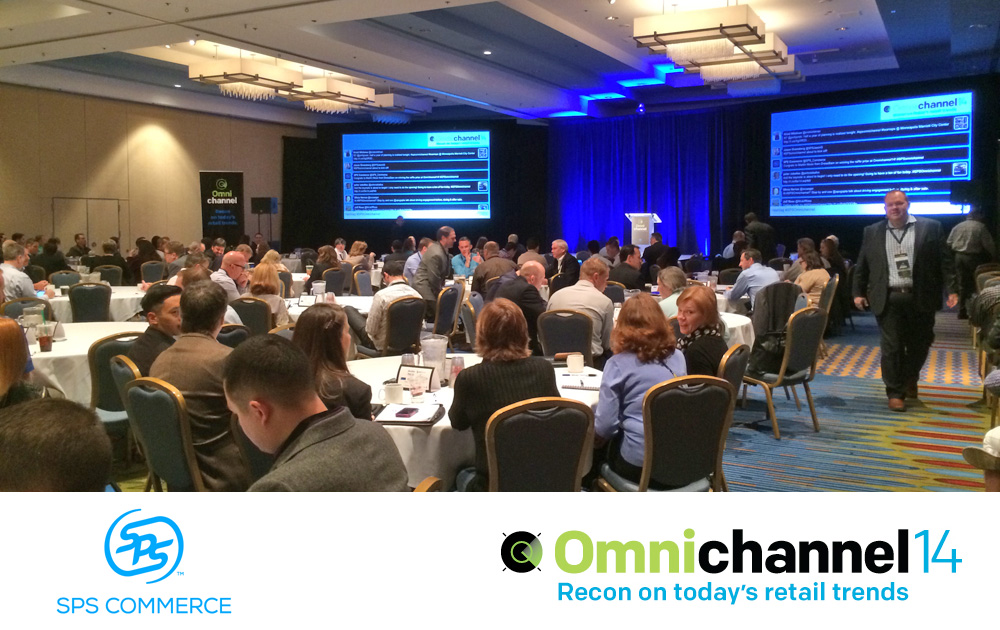
This week SPS Commerce held their Omnichannel 14 event at the Marriott in downtown Minneapolis (recap here). The morning kickoff session on Monday was standing room only, much better attended than even the SPS team obviously planned for in advance.
Why so much interest in supply chain infrastructure software and services, especially from a company that did just over $104M in revenue in 2013? (2013 annual report PDF) Because of the huge challenges facing retailers as they try to compete with the accelerating changes caused by internet connectedness: ecommerce; social influence; supply chain efficiencies; and an constantly increasing level of expectation on the part of the consumer. A consumer who increasingly can get what they want, when they want it, at the best possible price, and it better come from a retailer that “gets it”.
Retailers have to make certain they can satisfy that consumer and also stock (or have instant access to) the products to back it up. If they don’t, the consumer is a click or touch away from buying elsewhere.
We’ve also been wondering why a serial entrepreneur who could go anywhere, Jamie Thingelstad (seen walking down the aisle in the photo above), would end up as the CTO at this small supply chain company. After hearing about their big vision at this event and talking with Jamie, it became clear that the enormity of the opportunity, and SPS’ position in the marketplace, makes this company a great place to work!

SETTING THE STAGE
SPS COO, Jim Frome, set the stage for the entire event with his kickoff presentation. He went through the historical view of omnichannel retail (previously dubbed “multichannel”) and what happened to lead us to the present day. A day where continued economic uncertainty is still negatively impacting retail and ecommerce is no longer a bolt-on: it must be an integrated experience. A day when the channels and ways in which consumers can buy are exploding and products are coming to market so fast that keeping up with item demand is incredibly difficult.

Jim Frome
Frome went on to lay out how social media has become a dominant way people participate online (240m Twitter users and 1.23b Facebook users) which is driving purchase behavior, something traditional supply chain companies rarely even think about let alone bake in to their strategies.
He also laid out how the ubiquity of mobile is another key factor that is making it very hard for retailers to always be at the point of purchase when the customer is ready to buy. With 180m tablets & 1B smartphones in use there is an obvious and absolute requirement to have a digital presence but it’s more than that. The key is to be available to engage with the always on, always connected mobile user regardless of where they happen to be at the moment and whether or not that are even actively interacting with the retailer.
Competitive pressures are huge and accelerating too. From same day delivery to the growing mandate to significantly increase the items available in a retailer’s assortment, make the challenges facing retailers enormous.
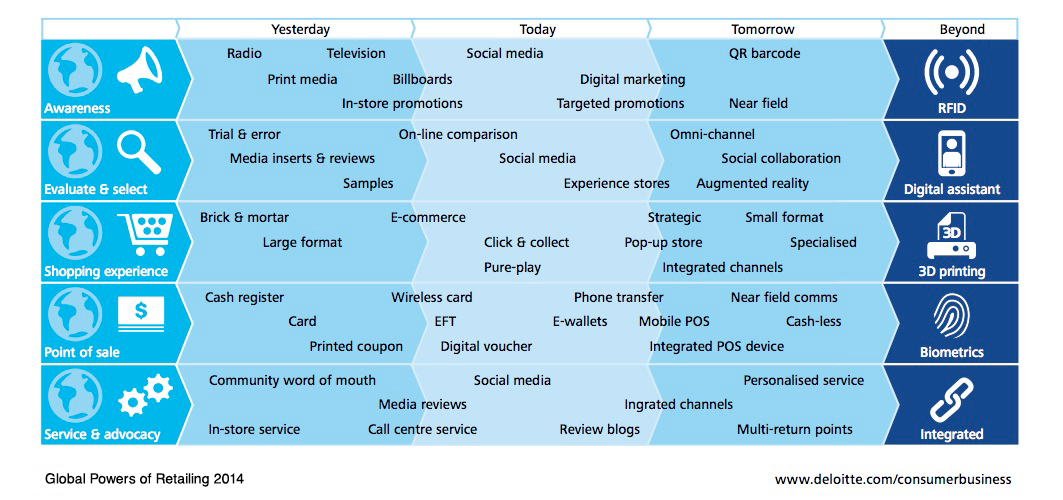
Don’t think retailers have many challenges?
Look at this representation from Deloitte’s Global Powers of Retailing 2014 report (PDF)
Many of us not directly involved in retail probably have little clue about all the moving parts in the supply chain that leads up to the retailer and, in turn, to the consumer.
Several of my colleagues think “the big retailer challenge” boils down to showrooming and Amazon. Even though competing with Amazon is something many retailers contend with (both bricks-and-mortar and ecommerce ones), the challenges go far beyond that company in Seattle!
What do retailers think are their top issues? Deloitte report Global Powers of Retailing 2014 (PDF) had the graphic above which gives you, at a glance, at least an idea of the sorts of pressures retailers are facing. The sheer number of variables are overwhelming which is the primary reason why retailers are increasingly seeking strategic solutions, like those from SPS Commerce, to deal with the onslaught.
The Fourth Annual State of the Retail Supply Chain Report (PDF) by Auburn University and Retail Industry Leaders Association, is another good read. This report laid out the critical issues weighing on the minds of the 75 supply chain executives surveyed (from top retailers around the United States) but the top four hot button issues are key to understanding what is driving top retailers…as well as the concerns of leaders at smaller regional chains or individual stores:
1) Managing network growth (i.e., store and geographic expansion)
2) Serving omnichannel demand
3) Optimizing resource utilization
4) Navigating regulatory environment
Yep. Omnichannel is #2. So what would a smart strategy and big vision be for a retail supply chain company like SPS Commerce to execute on for 2014 and beyond?
THE BIG VISION
SPS is already well along the way toward having a critical mass to execute on a big vision: They have 50,000 in-network partners; source 1.3 million products from 7,000 companies (the largest in the world); have 35 million UPCs managed; support all fulfillment models; are deployed in 300,000 retail locations; and have a great reputation.
One way to see that in action is this press release that came out right after NetSuite’s CEO, Zach Nelson, talked about it on stage Monday afternoon: NetSuite And SPS Commerce Deepen Product Integration To Deliver Intelligent Commerce Collaboration. It describes how and why an alliance between NetSuite and SPS Commerce happened, why it makes sense, and what it will do.
Not only will SPS Commerce be able to tap in to NetSuite’s 20,000 customer base, NetSuite can integrate SPS’ supply chain capabilities and software into their platform. A classic win-win partnership and I’ll bet the first of many, especially as SPS’ vision becomes more well known.
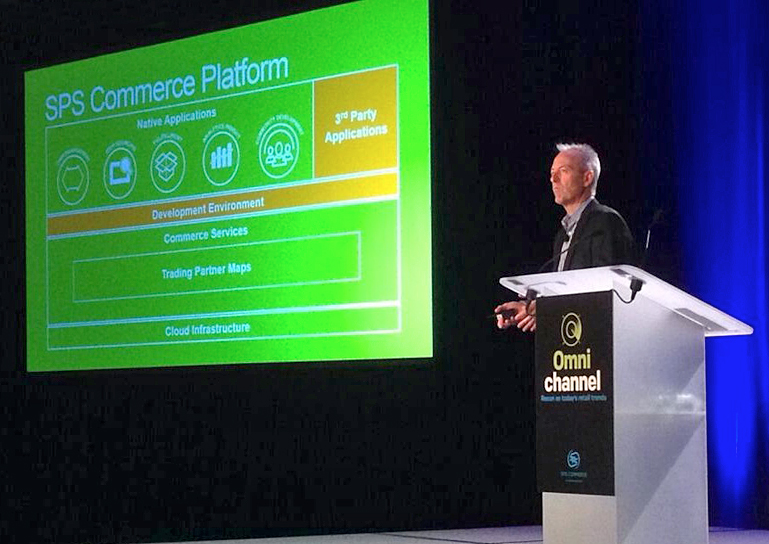
Jim Frome & the big vision
(photo by @thingles)
SPS Commerce describes themselves as having “...the industry’s most broadly adopted, retail cloud services platform” and as “… a leader in cloud-based supply chain management solutions“. What I didn’t know was the extent to which SPS “...provides numerous prewired, proven integrations and comprehensive retail performance analytics to thousands of customers worldwide. With a singular focus on the retail marketplace, we revolutionized traditional EDI systems by developing a platform that enables highly cost-effective and reliable trading partner collaboration.” (my emphasis in bold)
There is that word “platform.” One we all hope to hear and read about when we look at how a company might scale, create an ecosystem, accelerate customer acquisition, and potentially grow like mad.
Without going in to great detail, just know that SPS has an already solid and growing customer base, partners in place and an already vibrant and emerging ecosystem. If they keep growing it at the pace they’ve been at, it will be interesting. If their ecosystem leaps forward like many suspect (and we are in that camp), then SPS Commerce is poised to become the dominant player in the omnichannel space.
SPS Commerce can do so because they have all the right pieces and parts already (and need to add more), don’t have to deal with enormous legacy software and major customer implementations stretching back to years before the internet, and can move quickly to execute on their vision for a smart, capable, scalable and ubiquitous supply chain. One that has partner extensions that will extend it in ways we cannot yet predict.
With a CTO like Jamie Thingelstad on board—someone who intuitively understands scalability, ecosystems, platforms, the web, social media, and all the ways in which these are impacting retailers and the supply chain itself—SPS has a bright future when it comes to the technology to drive their platform.
 Software Firm 8thBridge Sold But Plans Expansion


 offering. The GoMLS app (see the iOS version













 Several hundred tech lovers crammed into
  The Minnesota-based SaaS company