Minnov8

Showcasing Minnesota Technology Innovation

  • Home
  • Minnov8 Gang Podcast
    • Complete Podcast Posts
    • MP3 Archive of All Episodes
  • Blog
  • About
  • Contact

Digi’s New XBee® Wi-Fi Cloud Kit

November 19, 2013 By Steve Borsch

digi-kitDigi International today announced their new XBee® Wi-Fi Cloud Kit which “Brings the Internet of Things to Everyone.” Their objective with this ‘kit’ is to “Add cloud connectivity to any device or sensor–create your own Internet of Things ASAP.”

Check out their press release below and go to the “XBeeCloud” and see examples here.

New XBee® Wi-Fi Cloud Kit by Digi International
Brings the Internet of Things to Everyone

Add cloud connectivity to any device or sensor–create
your own Internet of Things ASAP (#IoTASAP)

MINNETONKA, Minn., Nov. 19, 2013 /PRNewswire/ — Digi International (NASDAQ: DGII) today released the XBee® Wi-Fi Cloud Kit, a development kit that allows anyone to build, connect, and control their own Internet of Things. The kit recently won an Editor’s Choice ribbon at World Maker Faire New York 2013.

Built around Digi’s new XBee Wi-Fi module, which wirelessly connects devices to the cloud, the kit integrates with Device Cloud by Etherios™ using a sample internet-based application, and includes a new development board with sensors, actuators, a USB cable, and a variety of electronic prototyping parts for creating custom circuits.

“The new XBee Wi-Fi Cloud Kit is the fastest and easiest way to explore and develop devices and circuits that connect to the Internet of Things,” said Rob Faludi, chief innovation officer and author of Building Wireless Sensor Networks. “Through its straightforward integration with Device Cloud by Etherios, makers, educators, electronics engineers, software designers, and innovators of all kinds can now create their own Internet of Things through easy-to-use web applications.”

The XBee Wi-Fi Cloud Kit features a sample web application that lets users remotely activate various outputs on the development board including LEDs, a vibration motor, a bar graph gauge and an audio buzzer.

In addition, users can build their own circuits on the development board to sense temperature or light, switch on and off other devices via a relay, turn on and off additional LEDs and more. The web application code is open-source, available for anyone to download and use as a learning tool.

The XBee Wi-Fi Cloud Kit is now available for $149 MSRP. For more information or to buy your kit, visit: http://www.digi.com/xbeecloud. See examples here and take part in the conversation on Twitter with the hashtag #IoTASAP.

About Digi International

Digi International is the machine-to-machine (M2M) expert, combining products and services as end-to-end solutions to drive business efficiencies. Digi offers the widest range of off-the-shelf M2M hardware. Etherios, a division of Digi International and a Salesforce.com platinum partner, helps organizations of all sizes achieve their business goals with capabilities encompassing advisory, CRM, wireless design and M2M services. Etherios also offers cloud-based products, Device Cloud by Etherios and The Social Machine. Together, Digi and Etherios offer the only complete end-to-end M2M solution. More information can be found atwww.digi.com and www.etherios.com.

All brand names and product names are trademarks or registered trademarks of their respective companies.

SOURCE Digi International

Copyright 2013 PR Newswire

###
Filed Under: Internet of Things - #IoT, New Tech from MN Companies, Newsbytes

SmartThings Announces New Financing

November 12, 2013 By Steve Borsch

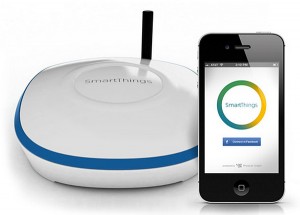
smartthingsAlex Hawkinson, CEO & Founder of SmartThings, wrote this post today announcing their new A round of financing:

Today marks a very important milestone for our young company, and we would be remiss if we didn’t take the time to thank everyone who has made it possible. As you may have seen, we’ve just announced our next round of funding from two premier venture capital firms: Greylock Partners and Highland Capital Partners.

Congratulations to Alex and the entire team. We are looking forward to new product, new distribution and an acceleration in to the Internet of Things (IoT) space!

For your viewing pleasure (since many people I’ve talked with about SmartThings have not seen this video) this Twilio video shows a demo by Jeff Hagins, Founder and CTO of SmartThings, talking about the Internet of Things (IoT) and the physical graph (Note: Twilio is the company that SmartThings uses to send notifications to those of us using their products and apps!).

Filed Under: Internet of Things - #IoT Tagged With: IoT

A Fix for US Under-Employment?

October 29, 2013 By Graeme Thickins

vBench-Logo_250wvBENCH thinks it has one solution. The startup, cobased in the Twin Cities, announced today a U.S.-only “talent exchange” that seeks to counter the massive amount of contract work that Americans lose out on, year after year, due to “offshoring.”  Yep, let’s hear it for “onshoring” — keeping more of that work here in the good ol’ USA!

The wave of contingent workers continues to build, says vBENCH, with many reports citing a shift away from the 40-hour work week to a more flexible, on-demand workforce. JTEberly-Cofounder_vBENCH-125wCofounder JT Eberly (based here) notes that, though the official U.S. unemployment rate is now around 7.2%, “many experts believe the actual figure is in the mid-teens when you look at those who are underemployed and have stopped looking for work.” A large number of those have either done contract or freelance work in the past, or could start doing it — IF there was a better, more efficient way for them to find work and get paid for it quickly and efficiently.

“We believe a significant number of highly skilled U.S-based professionals remain undiscovered, underutilized, and unemployed,” Eberly said. ” At vBENCH, we’re out to empower this onshore talent pool with a platform to establish themselves as ‘solopreneurs’ — so we can keep lots more income here at home.”  Beginning today, at www.vBENCH.com, any hiring company can post a project for no cost, and independent contractors in a wide variety of professions can sign up for a free profile.  Read today’s full news announcement here.

Filed Under: MN Entrepreneurs

Tedx Comes South of the River

October 29, 2013 By Phil Wilson

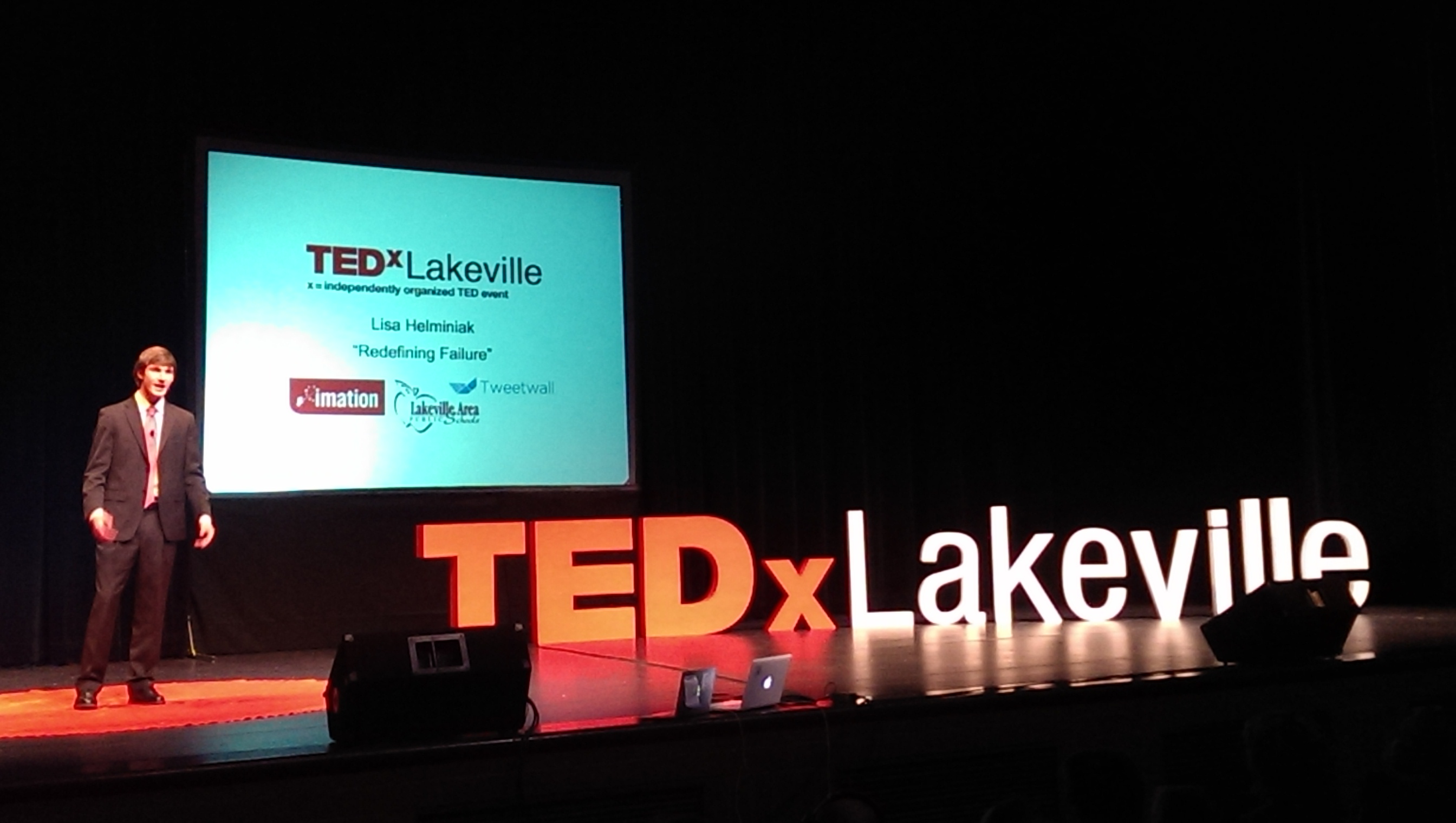
IMAG0230Lakeville saw it’s first Tedx on Monday night…and Lakeville was impressed. Ok, not all of Lakeville saw it, but about 150-200 of its residents did. In case you’re not familiar with Tedx, it’s the local, independently organized version of the popular Ted Talks that have been popularly educating audiences, and YouTubers, on everything from driverless cars and neuro-science to global warming and conservation through using only one paper towel to dry your hands.

Tedx Lakeville was spearheaded not by some local brain trust, board or politician, but by a senior at Lakeville South High School (I know, right!). Dylan Adelman is by no means the embodiment of a stereo-typical high school senior guy. He shows very few signs of ‘senioritis,’ waiting for high school to end so he can celebrate the “Summer of Dylan.” Instead he decided Ted, and its series of short presentations, needed to come to Lakeville and he made it happen. The result was “The Next 100 Years: The Future of Politics, Education and Technology.”

So how did it go? In a word…fantastic. Ok, the placement of a tweet wall to the left of the stage was troubling. If you know me at all, you know I despise the tweet wall during speaking events. It’s distracting, a source of pointless tweets and a trolls playground. Not to mention it’s just plain rude to ask a speaker to present only to enable an insane distraction to their topic and presentation…(Oops, I’m ranting). I’m happy to say, after a few Taco Bell tweets, cooler heads prevailed and the tweet wall was turned off. (Well played, all.)

Topics included presentations from local business leaders. politicians, educators and students. They presented on subjects including, Redefining Failure, The Digital Self, Quality Candidates and Education and more. I was particularly taken with the Discovery Learning presentation by U of M Junior, Anthony Fleck in the first half of the show. However, the second half is where Tedx Lakeville took off.

I was most impressed with the last two presentations of the evening. Betsy Grawe, a teacher in Lakeville, presented “Going Off Script”. It was a great combination of the perception vs. reality of the thinking of that group known as millenials. It included results of a poll of Lakeville millenials compared to national numbers. But more importantly it conveyed the message for them to not follow the script for life that has been presented to them.

Finally, Matt Little, Lakeville’s 28 year-old Mayor presented an incredibly well prepared look at solving our current political gridlock in “Beyond Bipartisanship.” His desire to for each political party to take a more pragmatic view to serve the constituency rather than their own party was very interesting and indicated to me that the mayorship will not be the only stop on his public service journey.

All in all Tedx’s trip south-of-the-river was well put together. It lacked only in preparation and focus by some of the presenters that lead to some disjointed and unnecessarily long presentations. The topics were sound and the execution of the event itself was incredibly well done. Mr. Adelman was a standout as he deftly transitioned from presenter to presenter. This guy is a rock solid speaker and, with the help of his team and advisors, delivered a rock solid event. (If no one has said it to him yet, “This will look great on a resume.)

I can’t wait for the next edition of Tedx Lakeville.

Filed Under: Edutech, Events, News & Events, Thought Leaders

Focus on Mobile at MobiU

October 25, 2013 By Phil Wilson

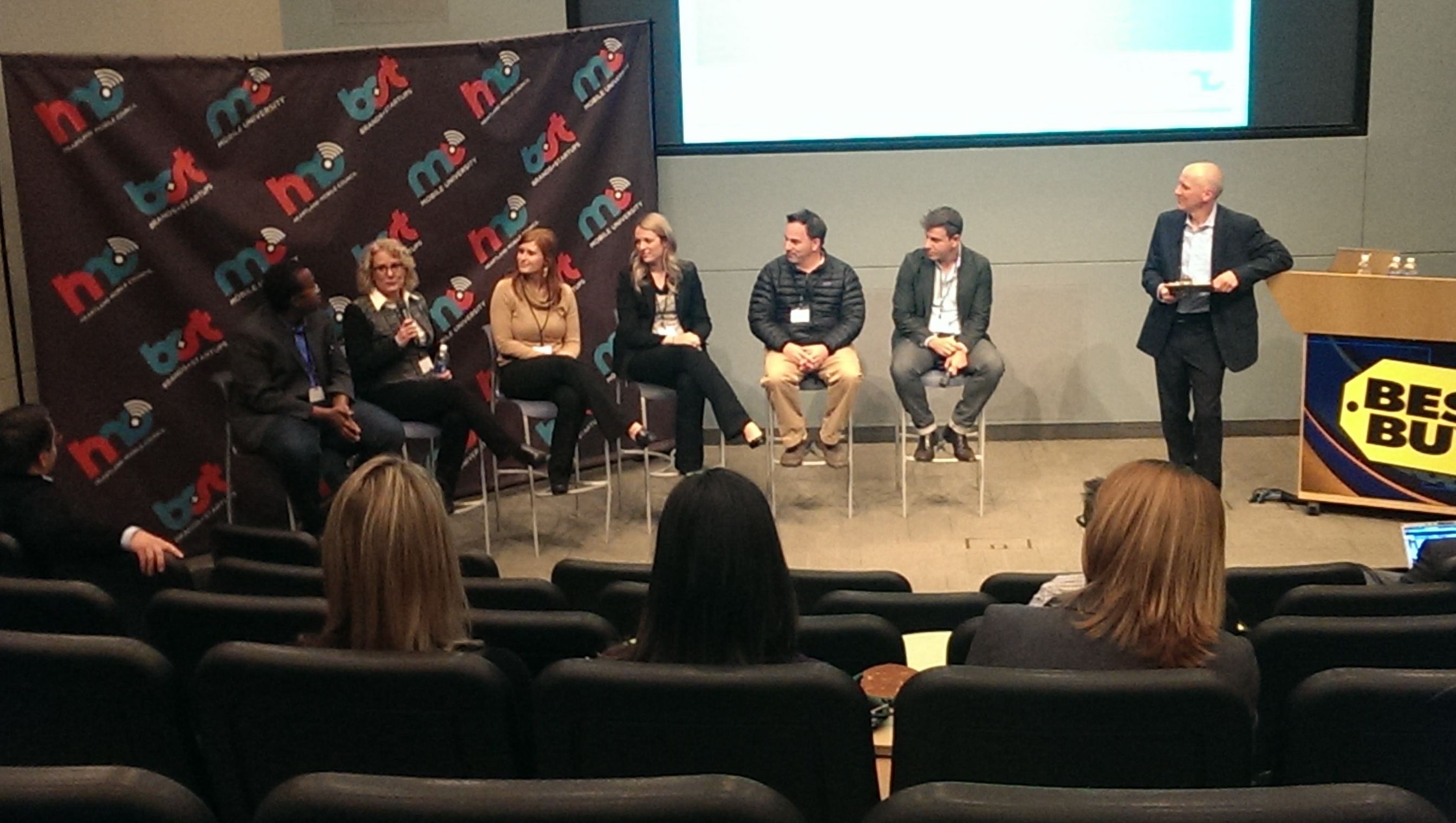
IMAG0225The first ever Mobile University, or MobiU, rolled into Best Buy Headquarters on Thursday evening to talk about the Mobile Path to Purchase with some 50 attendees.

The agenda, presented by Heartland Mobile Council, included panels addressing mobile insights and lessons learned about the use of mobile in the consumer purchasing cycle.

What I was most impressed with was the focus group that was assembled to find out how “real” people use mobile in relationship to their buying habits.

While my first impression was that many in the focus group were perhaps more tech savvy than average, some were from Best Buy, there were enough mainstream consumers to offer some insight. Takeaways from the session included: the use of push notifications are clearly annoying and the first thing the group deactivated after signing up for a retail loyalty program. These notifications included both native and text messages.

Comments also highlighted some disconnect with brands and the technology they use. One participant noted that pricing not always matched between the mobile app and the store. Additionally, when I asked if any ever presented a mobile code or coupon to someone in a store, only to to be met with an unknowing blank stare, there were plenty of “yes” responses. And, while many went on to say that they could eventually find someone who was ‘in the know,’ they really shouldn’t have to.

The best part of the Focus Group panel were the ideas generated by the panelists themselves on what brands like Best Buy, Target and Cub could provide on a mobile platform, including helping locate specific products bia GPS.

The Heartland Mobile Council is a Chicago-based non-profit organization whose mission it is to educate brands on how to use mobile effectively. Founder Hugh Park Jedwill kicked off the evening with some remarks including plans of launching incubators and more events around the country. He emphasized that the MobiU was a “safe learning environment” where brands were welcome to take part, but not sell or make pitches. In fact, he talked so much about that environment and the actual Heartland Mobile Council, it started to sound much like a pitch itself.

All in all, the event was a solid evening of learning and exchanging of ideas. Any organization that can precipitate that kind of interaction on the topic of mobile is great…and needed to effectively capitalize on mobile technology.

Filed Under: Events, Mobile Technology

AdWords Is Too Complex – Adagogo is a Better Solution

October 21, 2013 By Graeme Thickins

Adagogo-logoWhat if you could post an ad in three minutes and geo-target it to mobile users in a given radius around you — or across an entire network of 45 to 50 million of them — then start seeing results minutes after that? Well, you can — I know, I did it, with a new self-serve ad service called Adagogo, soft-launched in recent days by mobile app platform company DoApp Inc. (www.doapps.com), based right here in Minnesota (Rochester and Minneapolis).

DoApp founder Joe Sriver began working at Google in early 2001 JoeSriver-headshotand knows a thing or two about online advertising. “After joining Google, I found out that I’d been about the 20th advertiser to sign up for Adwords. Also, I learned that Adwords was the reason my hire date was pushed a few months, as they were so heads-down developing it.”  As Google’s first UI designer, he soon became steeped in AdWords himself. “It’s a great product, and I’m proud to have been part of its history,” he said. However, it’s become complex, really complex. It’s gotten so new users either need to spend days trying to understand all the options it now offers, or hire a professional to manage their ad campaigns.” He doesn’t think that’s right.

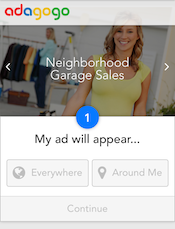
Screenshot-1“What’s been missing in all this,” says Sriver, “is an easy method to just get your web site, business, blog, or app in front a lot of people quickly.” (Hello, startups!)

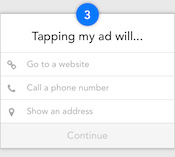
“I think we’ve developed the simplest way to quickly place your ad Screenshot-3within thousands of local and national apps, on all the major mobile app platforms,” said Sriver, “Our network of users today is substantial, between 45 and 50 million people, and it will continue to grow rapidly.”

Because you can target locally or advertise across the entire network, DoApp says Adagogo is “great for everything from getting traffic to local garage sales Screenshot-2to building national brand awareness.” How’s that for a bold addressable market?

Sriver recounted how he experimented with a lot of new ideas since he launched DoApp in early 2008. The company’s main app platform business (both Mobile Local News and Real Estate) continues to grow rapidly. (See my previous coverage of the company here, here, here, and here.) But, of all the new side-project ideas he’s played with over the years, Joe says Adagogo is the one he realized had the most potential to get traction.

How to Post an Ad with Adagogo:

> Choose geographically where you want your ad displayed
> Enter your ad copy and add a picture
> Select the amount of ad impressions you want to display
> Add a web site URL, phone number, and/or location
> Enter your credit card info
> DONE!

I Did My Own Self-Serve Ad Test
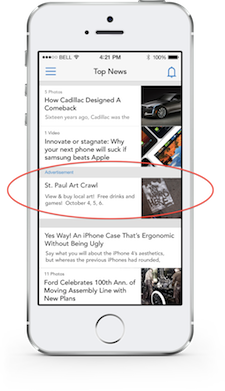
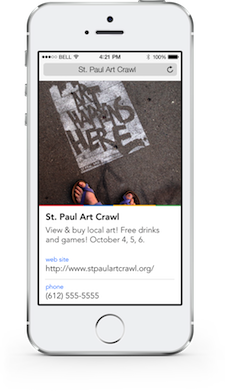
I set up an ad on Adagogo the other day just to experiment with it myself. And I must say, it was quite easy. Nice, intuitive UI — really simple and clean. Graeme_ad_BigDataMy ad is the shown here with the headline, “Learn About Big Data.” The goal was to drive traffic to a Flipboard magazine — which I had launched a while back on a lark — just to see how many people I could get to subscribe with a mobile ad. Joe told me that 1000 ad impressions, the option I chose (price: $25) would go quickly on the DoApp network — in about 2-3 minutes. He was right. I watched as my subscriber count went up 20%+ almost before my eyes. Once my ad impressions were used up, my click-through rate was 1.2%. Not bad, as the ad was just promoting a web site — to get people to subscribe to a free mag — not some giveaway, coupon offer, or contest.

Adagogo-ad-RedOval-225wSo, across what geography do users see the ads? “Many of our apps are local or regional news apps,” says Sriver, “but we do have a number of national and international news apps as well. You can either choose to advertise locally within a 5, 10, or 50-mile radius around a location specified by you. Or you can have your ad displayed ‘Everywhere,’ which means wherever our apps are used around the world.”  One of DoApp’s widely distributed news apps, with a worldwide footprint, is called Headlines.

“Across iOS, Android, Windows Mobile, and mobile web, we currently have more than 1500 apps,” says Sriver. Adagogo-ad-action“That number will be going up significantly, as all our real estate apps will soon have access to the Adagogo network. So our total number of available apps where Adagogo ads appear will grow a ton – stay tuned!”

Seriously, I can see Adagogo used for garage sales, fundraisers, local mom & pop stores, online businesses — even big brick-and-mortar retailers and, heck, ecommerce giants, for that matter.  A Best Buy, for example, could advertise individual store deals using local-radius targeting, but could also do general brand advertising across the entire 50-million user base – say, to hype a Super Bowl commercial, or a contest or sweepstakes. No special expertise required — really anyone can use the simple Adagogo interface.

“From our start, DoApp’s mission has been to help in the growth and success of communities and local businesses through new technology,” says Sriver. “Adagogo builds on that mission.”

A Special Offer This Month
In announcing the Adagogo soft-launch, Joe offered up a special promotion for Minnov8 readers.  With any ad package you purchase, the company will double your number of impressions. For example, buy the 1000 ad impressions package, get an addition 1000 for free (2000 total). Buy 5000, get a total of 10,000. This “buy one get one deal” is available only until October 31, 2013, and is for ads that are specified to run “everywhere,” as opposed to a specific location. Just place your ad before midnight Central time on October 31 and you’ll automatically get double ad impressions.

—————-

Postscript: See DoApp at MobCon
Wade Beavers, CEO of DoApp, will be speaking at a mobile technology conference coming up in Minneapolis, Nov 7-8: MobCon. (Online registration still open.)  His session and description: “It’s all about your latitude and longitude. How location is changing mobile.”
“Location and mobile are a perfect match. Learn more about how device latitude and longitude are changing the mobile game for advertising, social, commerce, personal data, and content distribution. A recent study showed that 43% of users were willing to provide their location to companies compared to less than 11% willing to share their browsing history. Has location information become the new cookie? You will learn: Location Data Trends, Effective Location App Offerings, Location Data Use, Consumer Behaviors, and Location Best Practices.”

Minnov8 will be reporting from the MobCon event, so look for us there!

—————–

Disclosure: DoApp is one of the companies in my client equity portfolio. I helped launch the firm in 2008, serving as its VP Marketing.

Filed Under: MN Entrepreneurs Tagged With: Android, iOS, mobile

CoCo Uptown Open House a Success!

October 11, 2013 By Steve Borsch

coco-uptownLast night was CoCo‘s open house for their new Minneapolis Uptown location and all four of the Minnov8 Gang attended along with several hundred of our closest friends.

The specs on this place were pretty impressive:

  • 160 Coworking seats for individual members
  • 9 medium campsites for group memberships)
  • The “Garage” – a 3,500-square-foot open space devoted to ideation, prototyping and presentations for groups up to 100
  • A small movie theater, for presentations and pitches
  • A billiard room that doubles as a meeting room.
  • A walkout patio, located within a beautiful green space
  • 2 large conference rooms
  • 6 private booths for phone calls and demos
  • A commons area that can be used for 100-person events and meetups

But it wasn’t until one is actually in the space that you get a sense of the possibilities and how fun it would be to tap in to that energy.

When you also consider that the Uptown area—and the increasing gentrification of blocks east with lofts being built and housing being remodeled—you can understand why CoCo carving out a space within it is a brilliant move. Learn more about the space here.

Don Ball, one of the co-founders of CoCoMSP alongside Kyle Coolbroth, Jeff Heegaard and Roger Heegaard, will be our guest Saturday on the Minnov8 Gang Podcast, episode 235. We’ll talk about the Uptown location, what’s going on with CoCoMSP overall, and what the future holds with co-working.

Filed Under: MN Entrepreneurs

What If We Stop Trusting The Internet?

October 11, 2013 By Steve Borsch

the_internetsWhat if the generic Top Level Domains (gTLDs) on the internet—like the ones we know and love like .com, .org, .net and so forth—collided with ones used by internal network names?

What if there were so many generic TLDs—so far there are 1,200 on the list with nearly 2,000 applicants—that your customers literally didn’t know what the hell to type in after the “.” when going to your website?

Mike O'Connor

Mike O’Connor

The push to add hundreds of gTLDs to the internet domain name space was an issue I had thought I understood. But it wasn’t until attending a talk by entrepreneur and smart guy Mike O’Connor last evening at U of MN’s Humphrey School of Public Affairs, that I began to understand the depth and breadth of the problem. The scope of the monetary incentives for the organization that runs the domain name system: ICANN, the Internet Corporation For Assigned Names and Numbers, is breathtaking too.

After Mike’s experiences co-founding the St. Paul internet service provider GoFast.net (PDF of an 1999 article on GoFast is here) and later running the Y2K program for the City of St. Paul staving off digital armageddon at the turn of the century. Then he became even more involved in various community adventures like when he was appointed by the governor to be on the Minnesota Ultra High Speed Broadband Task Force.

THE OPPORTUNITY
Turns out the push to add all of these gTLDs is pretty darn lucrative for ICANN. To sponsor a new gTLD isn’t cheap: the initial cost is $185,000 and the ongoing cost is $30,000 per year. Mike also surmised aloud that the fully burdened cost of sponsoring a new gTLD was closer to $500,000 and that was before promotion or marketing of it to drive awareness!

ICANN, a non-profit corporation, is poised to generate several hundred million dollars from adding all of these new gTLDs. Registrees and registrars (along with speculators) also stand to profit from the huge influx of new TLDs in the domain name system.

Of course, one could argue that new gTLDs also open up domain naming possibilities for the rest of us so we can stop dropping vowels in our names (e.g., Flickr; Tumblr, Socializr, etc.) and get exactly what we want.

But there is a looming problem that stands to change our level of trust when it comes to the internet.

THE PROBLEM
Mike laid out the problem in his talk and there is a lot more detail in this blog post. In essence the problem is:

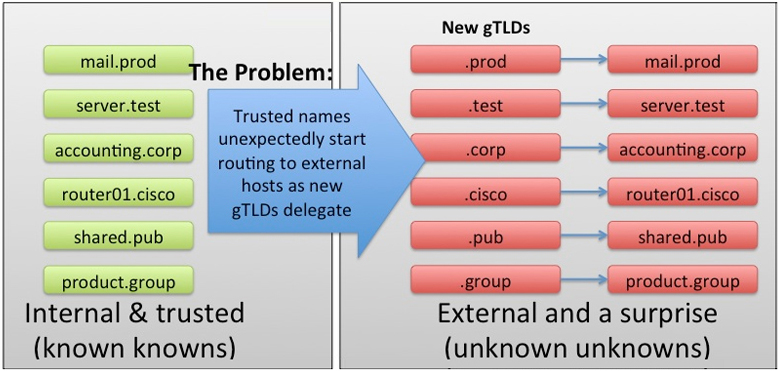
The new TLDs may unexpectedly cause traffic that you’re expecting to go to your trusted internal networks (or your customer’s networks) to suddenly start being routed to an untrusted external network, one that you didn’t anticipate.  Donald Rumsfeld might call those external networks “unknown unknowns” — something untrusted that you don’t know about in advance.  The singular goal of this post is to let you know about this possibility in advance.  Here’s the key message:

If you have private networks that use TLDs on this list, best start planning for a future when those names (and any internal certificates using those names) are going to stop working right. 

You might think, “Ahh…that doesn’t really affect my company or me” but imagine you work for a corporation and are in a coffee shop . You open your laptop and launch your mail program. It tries to connect to your internal network to retrieve your email BUT YOU FORGOT to launch your VPN first. Oops.

Since the way seeking works when you have an internet connection, your laptop now attempts to find your company’s internal mail server on the wider internet. Since a new gTLD proposed is the same as internal as an internal name, it would be trivial for bad guys to spoof your program and you’d end up on an untrusted source on the wider internet. Here is part of a diagram Mike showed last evening that will give you a sense of some of the conflicts that are certain to arise:

new_gTLDs

Mike is not alone in his concern. This article at the Domain Industry Journal said in part:

“…the Association of National Advertisers (ANA), who represents dozens of well-known global brands including AT&T, eBay, IBM, Intel and Microsoft, to name just a few (see the full membership list here), blasted ICANN over “woefully inadequate” preparations for the impending roll out of new gTLDs.“

Add to that the simple confusion by consumers on what TLD to use. Many of our readers have “.net”, “.mn”, “.name” and other TLDs and often are frustrated because everyone puts in “.com” as a reflex. Imagine trying to remember one of literally hundreds of gTLDs like “.inc” or “.bank” or “.cloud” and so on. It’s a marketing budget nightmare and a scammers dream.

Add another issue: the inadvertent searching on a string in your web browser bar where you forgot to leave a space (e.g., “best company on the market in routers.Cisco is the best?” brings up a “routers.cisco” webpage instead of a page of Google or Bing results.

The comment period is over at ICANN so we’re along for the ride as users, developers, service providers or just interested observers. But if you are someone who manages or runs a private network with any potentially conflicting namespaces, take Mike’s advice: start planning now.

m8-spacer

To learn more about the controversy and concerns, here are a few links:

  • Mike’s Posts:
    • What if people stop trusting the ICANN root?
    • New gTLD Preparedness Project 
  • Verisign blasts ICANN for rushed generic top-level domain name rollout
  • Clashes, Collisions, Delays and Decisions: ICANN, NTIA, Verisign and ANA Weigh In on ‘Name Collisions’ and the Readiness of the New gTLD Program
  • The Technical Impact of New gTLDs: Are We Pushing on Regardless?
  • Verisign report: New gTLD Security, Stability, Resiliency Update: Exploratory Consumer Impact Analysis (PDF)
  • New gTLD Security Implications

Filed Under: Internet & Society, Internet & Web

Comcast Partnering with CoCo for 1Gbps Fiber

October 10, 2013 By Steve Borsch

comcast-cocoGood news for anyone already (or planning to be) a co-working person or company at CoCoMSP‘s Minneapolis Grain Exchange location or at its new Uptown facility: Comcast is providing dedicated one-gigabit fiber network connectivity to CoCo’s growing entrepreneurial community.
More in the good news department too: This 1GB fiber connection is symmetrical (same speeds upload and download) but there is no word yet on whether or not Comcast Business terms of service allow, or disallow, hanging a server off of this connection!

Since bandwidth is so incredibly important this is a good move by Comcast and a smart partnership by CoCo.

Here is the press release:

CoCo Minneapolis and Comcast Business Announce
Partnership to Provide Startups and Entrepreneurs
1 Gigabit Ethernet Connection

High-Performance Ethernet Services Enable CoCo
Entrepreneurs to Access Ultra-fast Internet Speeds

October 10, 2013

MINNEAPOLIS–Comcast is partnering with Minneapolis-based CoCo coworking and collaborative space to provide dedicated one-gigabit fiber network connectivity to CoCo’s growing entrepreneurial community, including its downtown location in the historic Minneapolis Grain Exchange and a new Uptown site that opens today.

“At CoCo, we always need more bandwidth, so this type of resource is a huge opportunity for our members. We appreciate that Comcast is leading by example in supporting startups and mobile workers.”

The Comcast partnership gives CoCo members access to an entirely new level of Internet bandwidth, once only available to larger businesses. The Comcast one-gigabit fiber connection is hundreds of times faster than outdated legacy technology and is symmetrical to provide equally fast upstream feeds, allowing the kind of bandwidth necessary to meet the most demanding applications.

This cutting-edge resource demonstrates Comcast’s commitment to the entrepreneurial ecosystem and its dedication to helping foster business growth and innovation in the Twin Cities.

“The Twin Cities is among the most connected metropolitan markets in the country, due largely to the major investments we’ve made in our metro-wide fiber optic network,” said Jeff Freyer, Regional Vice President for Comcast Twin Cities Region. “The resources we’re providing CoCo and their clients through this one-gigabit connection are a perfect example of the kind of scalability we’ve built into our infrastructure to serve businesses of all sizes – as well as our residential customers – with a full suite of innovative and affordable products and services.”

Freyer continued, “We appreciate the opportunity to partner with CoCo and are excited to empower today’s technology entrepreneurs with this ultra-fast internet connectivity.”

CoCo serves more than 500 members across three locations in the Twin Cities, including Lowertown St. Paul, downtown Minneapolis and now in the growing Uptown neighborhood. CoCo’s membership consists of startups, freelancers, consultants, and increasingly, mobile corporate workers.

“The high-bandwidth, low-latency connection goes a long way to even the playing field with much larger businesses and tech centers with huge resources,” said Spark software engineer and CoCo member David Middlecamp. “The symmetric bandwidth supports creators of content and services, rather than just content consumption, and facilitates working remotely across the globe, or collaborating across millions of connected devices.”

“This is the type of resource many of our entrepreneurs need in order to develop new technology and grow,” said founding partner Don Ball. “At CoCo, we always need more bandwidth, so this type of resource is a huge opportunity for our members. We appreciate that Comcast is leading by example in supporting startups and mobile workers.”

About CoCo Minneapolis
CoCo is a community for tech and creative entrepreneurs, independent businesses and corporate workgroups. We offer inspiring environments where they can gather, share ideas, team up on projects and get work done. A CoCo membership is an alternative to working from home, the cubicle farm or the local coffee shop.

About Comcast Business
Comcast Business, a unit of Comcast Cable, provides advanced communication solutions to help organizations of all sizes meet their business objectives. Through a modern, advanced network that is backed by 24/7 technical support, Comcast delivers Business Internet, TV and Voice services for cost-effective, simplified communications management.

The Comcast Business Ethernet suite offers high-performance point-to-point and multi-point Ethernet services with the capacity to deliver cloud computing, software-as-a-service, business continuity/disaster recovery and other bandwidth-intensive applications. Comcast Ethernet services are significantly faster than standard T1 lines and other legacy technologies, providing scalable bandwidth from 1 Mbps up to 10 Gigabits-per-second (Gbps) in more than 20 major US markets.

For more information, call 866-429-3085 or visit http://business.comcast.com/enterprise.

Follow us on Twitter @ComcastBusiness and on other social media networks at http://business.comcast.com/social.

About Comcast Cable
Comcast Cable is the nation’s largest video, high-speed Internet and phone provider to businesses and residential customers. Comcast has invested in technology to build an advanced network that delivers among the fastest broadband speeds, and brings customers personalized video, communications and home management offerings. Comcast Corporation (Nasdaq: CMCSA, CMCSK) is a global media and technology company. Visit www.comcastcorporation.com for more information.

Contacts

Comcast
Mary Beth Schubert, 651-493-5775
Vice President, Corporate Affairs,
Comcast Twin Cities Region
Marybeth_schubert@cable.comcast.com

Filed Under: Internet & Web, Marketing Innovation

SharePlan from Code 42

October 8, 2013 By Steve Borsch

shareplanSharePlan from Code 42 Software, the makers of CrashPlan. SharePlan is a “…sync and share platform that keeps information flowing, teams collaborating and business humming—securely, in real-time, between all endpoints, from the get-go.”

It’s a product that hits the sweet spot of the angst felt by just about every leader in I.T. across the world: Employees are sharing files—oftentimes insecurely and using consumer-centric services like Dropbox. They are also increasingly bringing in their own devices (BYOD) and want to share files to their devices too. For anyone charged with the responsibility of security for their organization, this is the stuff of nightmares.

SharePlan nails what the enterprise needs: a highly secure (256-bit encryption); the option to self-host behind their firewalls; remote wipe and audit trails; and much more (complete list of features here).

They just released a recent webinar for enterprise prospects and you can learn more watching it below or, if you’re an enterprise representative, Request a Demo:

[youtube=http://youtu.be/QYNiZ9j8yfg]

Filed Under: New Tech from MN Companies

« Previous Page
Next Page »

Search

Minnov8.com Is Now An Archive

As of April 2017, Minnov8 posts and podcasts are now an archive as this site is no longer actively published. Thanks to all of you who have been reading and listening since our founding in 2008!

Minnov8 Post Categories

Connect with Minnov8

  • Email
  • Facebook
  • Twitter
  • YouTube

Minnov8 Gang Podcast

Page Update Notification

Be Notified When This Webpage Is Updated. Click “Ok” Below…

powered by ChangeDetection


Copyright © 2026 · Log in
This work is licensed under a Creative Commons Attribution-ShareAlike 4.0 International License.