The Man, the Artist, the Designer, the Podcaster…the Show

There are tremendous firms, organizations, groups, and entrepreneurs responsible for some amazing innovations. There is also one Minnesota resident behind the look, feel and sound of some of those innovations.

That person or “show” is Woodbury’s John Benson, aka Johnee Bee. Johnee runs his own firm; The Johnee Bee Show, specializing in flash design and illustration. His work can be seen all over the web. In fact, Johnee donated the banner art we use on Minnov8. Not only can you see his work, you can hear it as well. I caught up with Johnnee for what was a high energy, sound effect and character voice riddled, fast-paced discussion.

Johnee moved to Minnesota in 2004 — but why? “A woman…why else?” he says with a smile. His wife Cynthia was offered a position at 3M so, along with their Weimaraner dog, Sprocket, they came to the Midwest. To get a good idea of what this show is all about, let’s step back and get the full scoop on the colorful history of Johnee Bee. Not to conjure up images of that guy you knew (or were) in high school, but here’s how he became the ultimate AV guy. Read more

TinyURL: Making long URL’s short

Did you know that a tiny service used 1.5 billion times per month was created in Minnesota? TinyURL is a service I’ve used often (especially when using Twitter) and this creation by Blaine, MN developer, Kevin Gilbertson, is quite popular.

I was first alerted that this was a Minnesota creation by St. Paul Pioneer Press reporter Julio Ojeda-Zapata (column, blog) when he put out a ‘tweet’ on Twitter about the service’s Minnesota connection. Of course, I poked around to find out more and was just delighted on what I discovered.

Then sitting down to breakfast this morning with the StarTribune, I saw this article entitled, “TinyURL developer basking in website’s success” which covers the man behind TinyURL and a bit about the service. The article lays out how Gilbertson could make ~$1 million per month but chooses not to have annoying popup ads (thank you Kevin!). He makes enough per month that he apparently doesn’t need to work outside of making TinyURL better and is able to focus on his passion for unicycling (peek at the Strib article for more).

Julio’s writing, the Strib’s coverage and ours is fantastic for a new and successful Minnesota startup, but not everyone agrees that services like TinyURL are ones we should rely upon. Read more

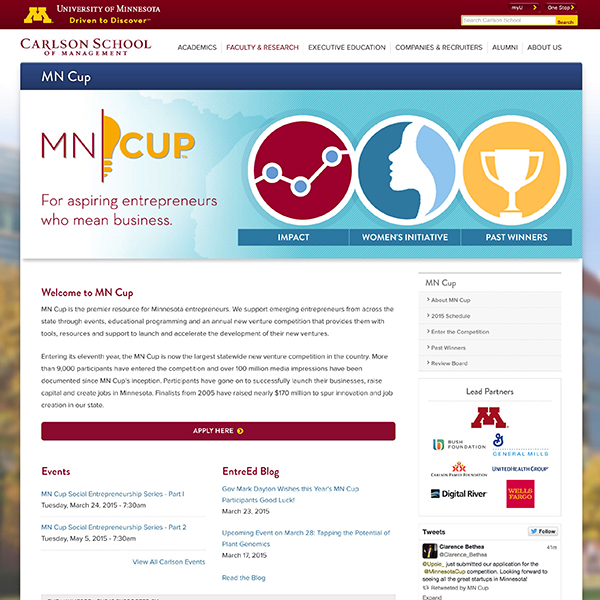
Thirty Semifinalists Named in ‘Minnesota Cup’ Business Plan Competition

I attended and Twittered a bit at a reception Wednesday evening, June 25, at the grand, old James J. Hill Library in downtown St. Paul. (You remember old J.J., don’t you, the Bill Gates of his era?) It was an event to honor the startups who made it to the next round of the Minnesota Cup, an annual, statewide competition that seeks out aspiring entrepreneurs and their breakthrough ideas. The 30 lucky semifinalists were selected from a record of 840 entries in this fourth and largest year of the competition, and will vie for prizes that include $50,000 in cash for the first-place winner. An interesting tidbit I picked up at the reception: about 10% of the 840 entrants were Web 2.0 related.

Scott Litman, cofounder of the event, told me the competition this year was the toughest ever, and that many plans that might have made the cut in previous years didn’t. He also told me that, unfortunately, many entrants may have had great business concepts, but they were not understandable — the submissions were either poorly written, or riddled with so many acronyms and buzzwords that the judges flat-out did not know what the heck the submitter was talking about. (So, take heart, rejectees. You may be great at selling your ideas verbally — now work on the written word.)

Here’s how the Minnesota Cup site states its mission: “We’re looking for the next great entrepreneurial success story in our state. This competition is for all entrepreneurs, whether your breakthrough idea is high tech or no tech, whether you are just putting your ideas into a business plan or if you’ve been out building your venture.” Well, I wonder if it’s possible that any who entered, and especially the chosen semifinalists, could really be “no tech” in this day and age? That would be hard to imagine. And, in looking over the list, there’s nary a one that would seem not to rely on technology in their businesses. (Although some without a website certainly have the aura of no-tech at this point, perhaps awaiting prize money to build? And what’s with all the student semifinalists being listed with no websites?) As for the lack of a requirement that the business be new, i.e., that older startups can also apply, I know at least two on the list are four to five years old and still chasing $50k. Ah, hope springs eternal. Here’s the full list: Read more

Kwingo Launches Mobile Language Apps

What do you do when you’re a successful, female, mid-career IT and operations executive with several big-name companies, and you decide to try something different? Why, you launch a mobile web apps company, that’s what!

Actually Lisa Foote first took some time to give back by using her executive skills for a year or so of non-profit charity work (with the United Way of Minnesota), after successful stints at Target, GE Capital, and Prudential. But it wasn’t long when the for-profit drive was back, and soon she was plotting, with husband Brad Roberts, a new business idea for solving language challenges in today’s increasingly global economy. And it just so happened that Web 2.0 technology was going to play a part — because Brad, who has a highly eclectic creative and business background, had become a self-taught Ruby on Rails developer.

The Birth of Kwingo
Foote and Roberts newly discovered life as entrepreneurs soon resulted in the birth of Kwingo.net, a venture they introduced earlier this year. Its mission is to bring simple, useful productivity tools to professionals working in field occupations using web-based mobile devices as a platform for delivery.

With her experience working in large enterprises, Foote knew that labor workforces were continuing to globalize, and that language challenges would just continue to multiply. Kwingo would provide the tools workers in the field needed to communicate with coworkers who speak a different language, helping everyone work more productively and safely. Read more

Commercial Real Estate Search Made Efficient

As the Internet increasingly becomes a platform upon which entrepreneurs and opportunists build disruptive and inefficiency crushing innovative Web applications, organizations like GoFishCommercial will emerge to do exactly that and make the inefficient, efficient.

After hearing about the company and taking the time to poke around the site, I had the chance to talk with Asher Silber, VP of Sales & Marketing for GoFishCommercial, in order to understand their current deliverable and a bit more about where they’re headed.

Kristi Oman (commercial real estate developer and property owner) and husband Zev, looked at the simplicity and effectiveness of Craigslist and knew they could build and deliver a site that would match that and add significant value to both the search process by buyers as well as to the owners of commercial real estate and their brokers.

What is particularly intriguing and innovative, however, is how GoFishCommercial has aligned the incentives of buyers, property owners and brokers, and done so in a disruptive and efficient way. Read more

Your Business Card for the Web

Throughout the last few centuries, people would meet and exchange trade, social, or what we now know as business cards, ensuring they could re-connect with one another if there was any interest or need in doing so again.

This ink on paper, manual handing out process was adequate in a day when contact information was relatively static and there were inherent limitations on the number of people whom we’d ever actually meet. In a time when 75% of adults are participating, communicating and engaging with others on the Web and meeting dozens, hundreds or in some cases thousands of others virtually, a static paper card is becoming much less useful. By the millions, we participating adults are engaged in numerous social networks and affinity groups, are blogging in record numbers, possess multiple email addresses and phone numbers, use Twitter, Skype and instant messaging accounts, and often have different identities with personal, business, or some other affiliation with required contact information that can often change frequently.

One Minneapolis company has created an innovative solution to meet those multiple identity needs with a digital equivalent of the trusty paper business card, one whose capabilities go far beyond what a static paper card could ever deliver. Read more

Bellying Up to the ‘Bar for The Seven Deadlies

Curt Prins at MinnebarAs part of Minnebar last Saturday I had the pleasure of sitting in on the “7 Deadly Mistakes of Start-up Marketing” presented by Curt Prins, marketing consultant focusing on emerging technology companies. In a full board room at Coffman Union on the U of M Campus, Curt took us through what he considers to the most common mistakes entrepreneurs make as they begin to develop and market their company or products. (I had a chance to Twitter those “mistakes” live but they deserve just a bit more focus.)

Mistake #1 Target Market Greed. A common problem that afflicts most new companies. In the quest to market to the most bodies, they target way beyond their sweet spot. The tighter the niche that you focus on the better results you will get. Curt demonstrated his point with a very simple “pie” chart. Cut out a slice, and then cut it again. Reaching that small piece of the pie will yield tastier results. Not to mention it’s a much better use of your marketing budget.

Mistake #2 Prospect Gluttony. Similar in nature to the above Target Market Greed, the more you wander outside of the group that really needs your product the more disappointing the results.

Mistake #3 Product Pride. It’s your baby! Clearly, it’s the answer to everyone’s needs…or do they even give a #*@? (Curt’s word, or rather, punctuation.) Your product is an extension of you and of course benefits you. Does it benefit your prospects? Read more

Minnesota’s Internet Tech Crowd Flexes Its Muscle

If one had any doubt about the intensity of our state’s information technology and Internet community, one only had to be anywhere inside the U’s Coffman Union on Saturday for the third annual Minnebar “unconference” (part of an international phenomenon called Barcamp). To say the joint was a-jumpin’ simply does not suffice. And numbers alone don’t tell the story (though attendance was an event record at 430). Rather, it was the intensity of energy through the entire day that could only impress one about this somewhat quiet, and definitely underrated, sector of Minnesota’s economy.

I was there for at least 12 hours of the event — yes, it went on that long, and no one was complaining — and I can surely say that even the most skeptical of attendees who sacrificed part of their spring weekend were impressed with what they experienced, and left beaming with an elevated sense of pride in the industry they’re a part of. One needs only to scan the voluminous talk that went on in real-time — thanks to the magic of Twitter, and all archived here — to see that something big was happening in the Gopher state on this rainy fishing-opener Saturday. (In fact, Minnebar was ranked during the day as one of the top-five conversations going on in the entire, global “Twitterverse.”) Read more

State of the State: Technology in Minnesota. A Minnebar Panel Discussion

One of the highlights of Saturday’s Minnebar was a panel discussion entitled, State of the State: Technology in Minnesota. The panelists included: Douglas Olson (Microsoft), Jamie Thinglestad (formerly of Dow Jones), Michael Gorman (Split Rock Partners), Robert Stephens (Geek Squad), Dan Grigsby (Unpossible), Matthew Dornquast (code42).

Ed Kohler at Technology Evangelist has a post with highlights here. You can also listen or download the one hour podcast below.

 
icon for podpress  Minnebar Panel Discussion [60:08m]: Play Now | Play in Popup | Download

‘Minnebar’ Becoming Top Event for State’s Internet/Software Developers and Entrepreneurs

An annual Minnesota event, playfully named Minnebar — which grew out of a grass-roots tech industry initiative called Barcamp — is happening for the third year in a row here in the Twin Cities this coming Saturday, May 10, at the U of M’s Coffman Union.
Minnebar logo By 8:00 am, somewhere between 300 and 400 software developers, startup founders (and hopefuls), web designers, interactive marketers, local media reporters, angels, VCs, and other investors will start converging in one place as they seldom do in any venue in these parts, at any other time throughout the year.

Coffman Union They come to talk shop, learn, share tips, listen to presentations on the latest tech developments and tools, share war stories, listen to startup pitches, and (of course) take notes, blog, and Twitter about all the proceedings on the laptops and smart phones they never seem to have far from their sides. Read more

Next Page →